Ghost + LinkedIn integration: how to distribute your blog to B2B buyers automatically
You published a blog post on Ghost. It is live. The sitemap is updated. Google will index it in three to five days.
And then nothing happens.
The post reaches twelve people — your subscribers, your team, and four bots. LinkedIn is where your buyers are, and your Ghost post is sitting on a subdomain they will never visit unless someone shows it to them.
That is the distribution gap. Ghost is an excellent publishing platform. It handles SEO fundamentals, sitemap generation, and clean structured output. What it does not do is move your content from published to read. Distribution is entirely on you — or on the system you build around Ghost.
This post covers exactly how to connect Ghost CMS and LinkedIn into one workflow: publish once, reach the right buyers on the platform where they are actually spending time.
Why Ghost and LinkedIn belong together for B2B SaaS
Ghost is built for content. LinkedIn is built for B2B attention. For a SaaS founder targeting other founders, heads of growth, or marketing leads, LinkedIn is the highest-concentration buyer channel available.
LinkedIn delivers 277% higher lead generation effectiveness than Facebook and Twitter combined for B2B audiences. More importantly, it is the only platform where your buyers self-identify their role, company size, and buying context in their public profile — meaning distribution there is not just reach, it is qualified reach.
The gap most Ghost blog operators leave open: they write the post and share it manually once. One post. One share. Minimal repurposing. The post gets 24 hours of organic reach and disappears.
The founders who build compound content engines treat each Ghost post as source material for five LinkedIn touchpoints — not one. And they build the workflow so those touchpoints reach buyers based on intent, not timing. That same principle applies to SEO: for the full ranking side of this, Ghost SEO automation setup covers keyword structure and AEO optimisation. This post covers the distribution layer.
What a Ghost + LinkedIn integration actually looks like
A proper Ghost + LinkedIn integration is not a simple auto-post.
Auto-posting blog URLs to LinkedIn is the lowest-value version of distribution. The click-through rate on naked link posts is under 2% because LinkedIn's algorithm suppresses external link reach. A shared URL reaching 2% of your followers is not distribution. It is background noise.
The high-value version transforms Ghost content into LinkedIn-native formats that the algorithm actually promotes:
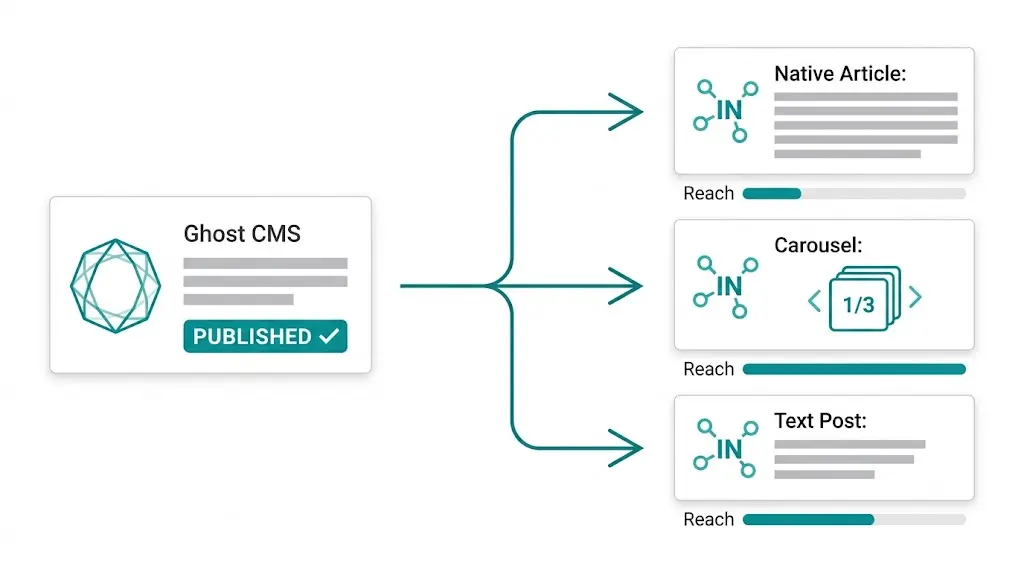
Ghost post published →
LinkedIn native article. A version of the Ghost post written for LinkedIn's article format — direct, opinionated, first-person. Shares the core insight without requiring a click to Ghost. Linked articles get indexed by Google, creating a secondary citation surface for the same topic.
LinkedIn carousel post. The key framework or data from the Ghost post turned into a five to seven slide carousel. Carousels consistently get three times the organic reach of link posts because they keep users on the platform.
LinkedIn text post. The strongest insight from the Ghost post turned into a standalone observation — no link, maximum reach, comment engagement that surfaces buying intent signals from your ICP.
Intent monitoring. LinkedIn searches for people asking the question your Ghost post answers. Thoth identifies those posts and drafts a contextual reply that references the blog post naturally.
Signal capture. Which LinkedIn format drove the most profile visits, connection requests, and inbound mentions — fed back into the next Ghost content brief automatically.
This is distribution that compounds. The Ghost post is the source. LinkedIn is the amplification system. And the engagement signals from LinkedIn feed back into what you write next on Ghost.
Step-by-step: connecting Ghost CMS to LinkedIn with Thoth
Step 1: Connect Ghost CMS to Thoth
Thoth connects to Ghost via the Ghost Content API. Once connected, every post published in Ghost — or promoted from draft to published — triggers the distribution workflow automatically. No webhook setup required on your end.
For the full Ghost CMS integration documentation, see Ghost CMS integration with Thoth. The API key setup takes approximately ten minutes.
Step 2: Define your LinkedIn distribution formats
For each Ghost post, Thoth generates three LinkedIn-native content pieces.
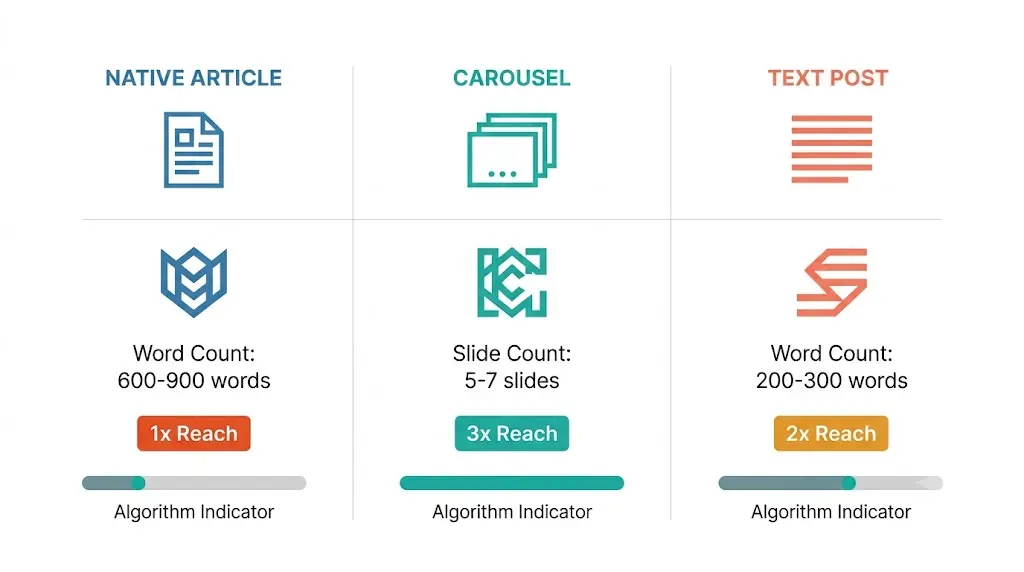
The native article. A 600 to 900 word version written for LinkedIn's article format. The opening hook is rewritten for LinkedIn's algorithm: direct question, bold statement, or surprising statistic in the first line. The core framework is preserved. The CTA points to the full Ghost post for readers who want depth.
The carousel brief. Five to seven key points extracted from the Ghost post, formatted as slide-by-slide bullet points. Thoth generates the slide structure and copy. You review and design runs through a Canva template or Figma component connected to your brand guidelines.
The text post. The single most shareable insight from the Ghost post, written as a standalone observation with no external link. This is the highest-reach LinkedIn format and the best for generating comments — which are the highest-value signal for identifying buyers actively thinking about the topic.
Step 3: Set intent monitoring keywords
Thoth monitors LinkedIn for posts containing the exact questions your Ghost post answers. If your Ghost post covers Ghost SEO automation, Thoth watches for posts asking about Ghost blog ranking, Ghost content strategy, and Ghost CMS SEO setup.
When a matching post appears, Thoth drafts a contextual reply that adds genuine value and naturally references your Ghost post as a resource. The reply is human-reviewed before sending — you see the post, the context, and the draft. One click to approve.
Step 4: Feed engagement back into content planning
Every LinkedIn content piece connected to a Ghost post creates data. Which posts get the most comments. Which carousel slides get screenshot shares. Which text posts generate profile visits from ICP-matched buyers. Thoth captures these signals and feeds them into the next Ghost content brief.
For teams also running LinkedIn prospecting for B2B SaaS buyers, the intent signals from distribution and the buying signals from prospecting combine in one pipeline — not two separate workflows.
The Ghost to LinkedIn distribution stack
| Step | What happens |
|---|---|
| Ghost post published | Thoth detects publish event via Ghost Content API |
| Native article | LinkedIn article version generated and queued for review |
| Carousel | Slide structure generated, sent to design template |
| Text post | Strongest insight extracted, standalone post drafted |
| Intent monitoring | LinkedIn searched for buyers asking the question your post answers |
| Reply drafts | Contextual replies drafted for human review and approval |
| Signal capture | Engagement data feeds next Ghost brief |
Manual time per Ghost post: 15 to 20 minutes for review and approval. Distribution output: Three to five LinkedIn touchpoints per post instead of one.
Ghost + LinkedIn vs Buffer or Hootsuite
Buffer and Hootsuite can schedule a LinkedIn post from a Ghost URL. That is where they stop.
The gap is intelligence. A scheduled link post tells LinkedIn to show your URL to some of your followers. It does not extract the framework from your post and rewrite it as native LinkedIn content. It does not find buyers asking about the topic. It does not feed engagement signals back into your content calendar.
For a SaaS founder publishing two posts a month on Ghost, the difference between one scheduled link post and five LinkedIn-native touchpoints is the difference between 50 impressions and 5,000.
Distribution scale is not about posting frequency. It is about format intelligence — understanding which LinkedIn content formats reach your audience and which get suppressed by the algorithm. For the broader picture of how this connects to AI search visibility, AI citation tracking for your blog content covers how LinkedIn mentions become AI citation signals over time.
FAQ
Ready to connect Ghost and LinkedIn? [Get a free AI visibility audit at distribution.studio](https://distribution.studio) — see your Ghost SEO, AEO, and GEO gaps in 10 minutes, then build the distribution workflow that puts every post in front of the buyers who need it.
Back to all blogs