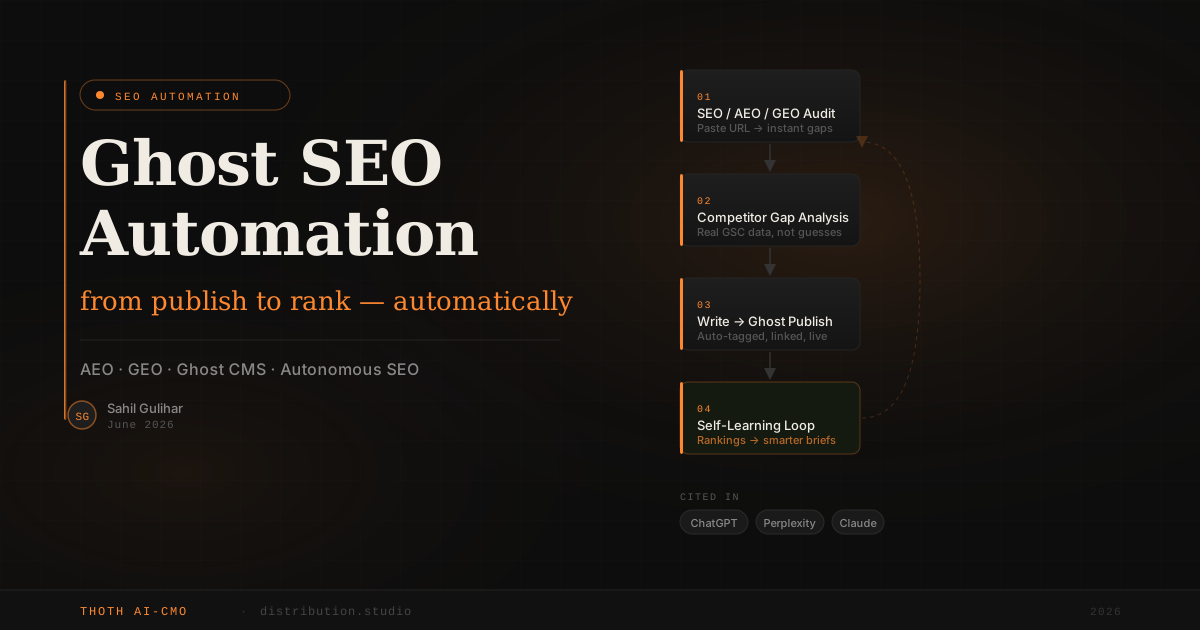
Ghost SEO automation: how to turn your Ghost blog into a ranking machine
Your Ghost blog is publishing. Nobody is reading it.
You set up Ghost. Picked the theme, configured the custom domain, wrote a few posts you were genuinely proud of. Two months later, Google has indexed three pages and your organic traffic is eleven visits — eight of which are you checking whether Google has indexed your pages.
This is not a Ghost problem. Ghost is a genuinely good publishing platform. Fast, clean, SEO-friendly out of the box, no WordPress bloat, no plugin sprawl. The problem is that publishing is one step in a system — and most founders treat it like the whole system.
SEO without strategy is journaling in public. And Ghost, for all its strengths, does not tell you what to write, who to write it for, or whether anyone is ever going to find it.
That is the gap. And it is the gap that kills most Ghost blogs before they ever gain traction.
Why Ghost blogs stall
The failure mode is almost always the same. You write about what you know. You publish when you have time. You share it on LinkedIn once, collect seventeen likes from people who are not your customers, and move on to the next thing.
A few weeks pass. You check Search Console. Nothing moved. You write another post. Same result. Eventually the blog becomes a low-priority item that you keep meaning to get back to. The blog goes quiet. The competitor who had a worse product and a better content system starts appearing everywhere.
This is not a writing problem. Most SaaS founders who struggle with Ghost SEO are clear, specific, and interesting writers. What they are missing is a system that tells them what to write, structures it for the right audiences, and actually gets the content in front of people looking for it.
That is an intelligence and execution problem. And intelligence and execution problems respond well to automation.
What "SEO-friendly" actually means for Ghost
Ghost markets itself as SEO-friendly, and that description is accurate — but it is easy to misinterpret what it covers.
Ghost handles the technical baseline well. Clean HTML output. Fast page load times. Canonical tags. Automatic XML sitemaps. Structured metadata. These are table-stakes requirements for any modern publishing platform and Ghost delivers them without configuration.
What Ghost does not do is anything above the technical baseline. It does not tell you which keywords to target. It does not analyse your competitors. It does not structure your content for AI answer engines. It does not publish to a topical cluster strategy. It does not monitor what is ranking and adapt your next post accordingly.
"SEO-friendly" means your content will not be actively penalised by technical issues. It says nothing about whether your content will rank, get cited, or drive qualified traffic. That part is entirely on you — or on the system you build around Ghost.
The three layers of modern search visibility for Ghost blogs
Before you fix your Ghost SEO, understand what you are actually optimising for. In 2026, search visibility operates across three distinct layers — and most Ghost blogs are only addressing one.
Layer 1: SEO — Traditional search rankings
Crawlability, indexation, keyword targeting, backlinks, internal linking, page speed, Core Web Vitals. The goal is to rank in Google's blue link results for queries your buyers are searching. Ghost handles the technical prerequisites. You are responsible for the strategy: which keywords, which pages, which internal linking structure, which competitor gaps to close. See how competitor gap analysis for Ghost connects to this layer.
Layer 2: AEO — Answer Engine Optimization
Your buyers are not just typing keywords anymore. They are asking complete questions. "What is the best SEO tool for early-stage SaaS?" "How do I automate my Ghost blog?" "Is Semrush worth it for a founder doing their own marketing?"
Answer engines — Google featured snippets, People Also Ask boxes, voice search — pull directly from pages that answer questions clearly and concisely. If your Ghost posts are dense walls of prose with no clear structure, answer engines cannot extract what they need. You will not appear in the zero-click results that are increasingly eating click share from traditional rankings.
AEO-optimised content has a direct answer in the first 100 words, uses descriptive headings that mirror the question format, and includes FAQ sections that can be pulled into featured snippets without modification.
Layer 3: GEO — Generative Engine Optimization
Your buyers are asking ChatGPT, Perplexity, Claude, and Gemini for product recommendations. They are typing "best autonomous SEO tool for B2B SaaS founders" and reading a synthesised answer that cites two or three sources. If your Ghost blog is not one of those sources, you do not exist in that moment.
GEO is about entity clarity, comparative context, and citation-ready structure. AI systems favour content that clearly states what a product is, who it is for, what it does, and how it compares to alternatives. Vague positioning gets ignored. Specific, structured, evidence-backed content gets cited.
AI citation tracking covers how to measure whether your Ghost posts are being cited across ChatGPT, Perplexity, and Gemini. What is llms.txt for your SaaS site covers the technical file that tells AI crawlers which Ghost pages are most authoritative.
The execution gap: what it actually takes to run Ghost SEO manually
Most SEO guides stop at strategy. They tell you what to do and leave you to figure out the execution. Here is what it actually takes:
Keyword research: 3 to 4 hours per month to pull GSC data, analyse competitor rankings, find keyword gaps, and prioritise topics.
Content briefing: 1 to 2 hours per post to research the topic, map the angle, outline the structure, and specify the AEO and GEO requirements.
Writing and editing: 3 to 5 hours per post if writing yourself.
Formatting for Ghost: 30 to 60 minutes per post to format, add meta title and description, configure the featured image, set up internal links, add schema markup, and verify everything renders correctly.
Monitoring: 2 to 3 hours per month to track rankings, flag drops, identify new opportunities, and update old content.
That is 15 to 20 hours a month for a minimal content operation. Most early-stage SaaS founders simply do not have those hours. The blog stalls. The content compound never starts.
This is the execution gap. And it is where automation stops being a nice-to-have and becomes the only way to actually run a content programme at founder scale.
What Ghost SEO automation looks like end-to-end
Autonomous SEO does not mean removing judgment from the process. You still make the strategic calls — which product angles matter, which audience segments to target, which competitive positioning to lean into. What automation removes is the execution grind.
Here is what the full automated Ghost SEO loop looks like:
GSC connects — you work from real traffic data, not keyword database estimates. Actual impressions, actual clicks, actual queries your audience is already using.
Competitor gap analysis runs automatically — the exact keywords your top five competitors rank for that your Ghost blog does not cover yet, ranked by opportunity size.
Topical clusters map out — posts are planned as clusters, not individual articles, so each new post strengthens the authority of the ones around it.
Content is written with AEO structure built in — direct answers in the opening, descriptive headings, FAQ blocks, definition sections, and comparison tables that answer engines can extract.
GEO optimisation is applied — entity clarity, structured data, comparison context, and citation-ready formatting for ChatGPT, Perplexity, Claude, and Gemini.
Published directly to Ghost CMS — formatted, meta-tagged, canonicalised, internally linked. You did not open Ghost once.
AI citation monitoring runs — which AI engines are citing your content, which competitors are being cited instead, and what content gaps to close next.
Self-learning loop activates — ranking changes, citation mentions, community replies, and engagement signals feed back into the system, making the next brief smarter than the last.
How to automate your Ghost-to-LinkedIn distribution loop
Writing the post is only half the battle. If your distribution is manually pasting the URL into LinkedIn once and forgetting about it, you are leaving most of your leverage on the table.
You can automate this entirely using Ghost webhooks, Make.com or Zapier, and the OpenAI API — so every time you hit publish, a high-converting social post is generated and scheduled automatically.
Here is the exact step-by-step workflow:
Step 1: Set up the trigger in Ghost. Go to Ghost Admin: Settings > Integrations. Create a custom integration called "Social Distribution." Create a webhook that triggers on Post published. Copy the webhook URL.
Step 2: Catch the payload in Make.com. Create a new scenario in Make.com starting with a Webhook module. Point your Ghost webhook URL here. When a post goes live, Ghost sends the full JSON payload including the title, URL, and HTML body.
Step 3: Strip HTML and generate the hook via OpenAI. Add an OpenAI module. Pass the raw post content into a prompt instructing the model to act as a B2B SaaS copywriter. The prompt should: extract the core thesis, write a contrarian or highly engaging opening hook, format it with line breaks for LinkedIn readability, and end with a CTA linking to the Ghost post.
Step 4: Push to LinkedIn. Add a LinkedIn module — Create a Text Post or Organisation Post. Map the output from the OpenAI module directly into the content field.
This loop takes about 20 minutes to set up. Once running, every SEO post you publish is immediately repurposed into a natively formatted LinkedIn asset, driving social signals and early referral traffic back to your site while Google takes its time to index the page.
For the full Ghost and LinkedIn distribution workflow including carousel and native article formats, see Ghost and LinkedIn distribution workflow.
Keyword strategy for Ghost: what to target and why
The single biggest mistake Ghost blog operators make with keyword strategy is targeting head terms they cannot realistically rank for.
A new Ghost blog targeting "SEO tools" or "content marketing" is competing against Semrush, HubSpot, Ahrefs, and sites with domain authority in the 80s and content teams producing five posts a week. You will not rank for those terms this year or probably next year.
What you can rank for — and what is actually more valuable — are the long-tail, high-intent comparison and evaluation queries your buyers search in the week before they make a purchasing decision.
"Semrush vs Ahrefs for early-stage SaaS." "Best autonomous SEO tool for B2B founders." "How to automate Ghost blog publishing." "AI SEO audit for SaaS startups." "Ghost CMS SEO setup guide."
These queries have lower search volume than head terms but the traffic they send converts. Someone searching "Semrush vs Ahrefs for early-stage SaaS" is further down the funnel than someone searching "SEO tools." They are in evaluation mode. They have budget intent.
The second mistake is ignoring GSC data in favour of keyword databases. Your Search Console shows exactly what queries are driving impressions to your site right now — including queries where you are ranking on page two and a few improvements could push you to page one. GSC data is the most valuable keyword intelligence you have. Most Ghost blogs barely look at it.
Looking at distribution.studio's own GSC data as a concrete example: "ghost seo automation" sits at position 34.89 with 9 impressions. "Ghost linkedin integration" at position 35.25 with 8 impressions. "Ghost blog automation" at position 50.5 with 8 impressions. These are near-win positions. Google has already decided this content is topically relevant. The gap between position 34 and position 5 is not more content — it is stronger internal links, FAQPage schema, and answer-first structure on existing H2 sections.
Building topical authority on Ghost
Google's ranking systems increasingly reward topical authority — the idea that a site covering a subject comprehensively and consistently is more trustworthy than one with a few isolated posts on unrelated topics.
For a Ghost blog, building topical authority means planning your content as clusters rather than individual articles. A pillar post covers the broad topic at depth. Supporting posts cover specific subtopics, linked back to the pillar.
A well-structured topical cluster for a Ghost SEO automation blog:
Pillar: Ghost SEO Automation — the complete guide
Supporting posts:
- How to connect Ghost CMS to Google Search Console
- Ghost SEO settings: the complete configuration guide
- AEO optimisation for Ghost blogs: getting cited in AI answers
- GEO content structure for Ghost: how to appear in Perplexity and ChatGPT
- Ghost vs WordPress for SEO: which platform wins in 2026
- How to automate Ghost publishing with AI
- Ghost CMS sitemap optimisation for AI crawlers
- Internal linking strategy for Ghost topical clusters
Each post targets a specific long-tail query with clear buyer intent. Together they establish your Ghost blog as the authoritative source on the topic. The pillar post benefits from the authority of the cluster. The cluster benefits from the pillar's ranking strength.
Ghost and AI crawlers: the llms.txt opportunity
Most Ghost blog operators have not addressed AI crawlers yet.
Search engines send Googlebot. AI systems send their own crawlers — GPTBot, ClaudeBot, PerplexityBot, Google-Extended — to index content for retrieval systems. These crawlers behave differently from traditional search crawlers and respond to different signals.
One signal becoming increasingly relevant is llms.txt — a standardised file that tells AI crawlers what content on your site is available for indexing and citation, and how to interpret it. It is a direct line of communication to the systems that decide whether your Ghost blog gets cited in AI-generated answers.
Most Ghost blogs do not have one. The ones that do are building an AI search visibility advantage that will be hard for competitors to close once citation patterns establish themselves. The full setup guide is at what is llms.txt for your SaaS site.
From Ghost blog to autonomous growth engine
Traditional SEO tools give you data. A consultant joins the data in their head, builds a plan, briefs a writer, reviews the draft, publishes, and monitors. That is 15 to 20 hours a week.
Thoth does the join in the workflow.
The biggest failure mode with Ghost SEO is stopping at setup. You pick the right theme, configure the sitemap, and call it done. But if your audit finds competitors being cited for your category keywords and your Ghost blog lacks answer-ready pages, the next step should not be another spreadsheet.
Thoth AI-CMO closes the loop between data and output:
From one URL: instant SEO, AEO, and GEO audit. No setup. No onboarding call.
Competitor gaps identified from real GSC data — not keyword databases.
Content written, AEO/GEO structured, and published directly to Ghost CMS integration automatically.
Reddit and LinkedIn monitored for warm leads mentioning your category.
Cold email written, warmed up, and sent — tone-matched to what is converting.
Self-learning memory: every campaign makes the next one sharper.
The compounding advantage
SEO compounds. Most people know this intellectually but do not feel it in practice because they stop before the compound curve kicks in.
The math is simple but the timeline is uncomfortable. A single post targeting the right keyword does a small amount of work — maybe a few hundred visits a month at peak. Ten posts forming a tight topical cluster do meaningfully more. A cluster with strong internal linking, consistent publishing cadence, and signals feeding back into the next round of briefs grows faster than a cluster without them.
Manual Ghost SEO breaks the compound loop every time the founder gets busy — which is always. You miss a month. Rankings drift. Competitors close the gap. You start over.
Automated Ghost SEO keeps the loop running whether or not you are looking at it. Rankings drop, the system flags it and queues a content update. A competitor publishes a strong post in your topical cluster, the system identifies the gap and briefs a response. A new query appears in GSC with growing impressions, the system adds it to the next publishing cycle.
That is not a tool. That is a growth system. And most Ghost blogs are running without one.
FAQ
Stop fighting spreadsheets. Get an autonomous SEO agent that audits your Ghost site, finds the gaps, and actually fixes them. Free AI visibility audit at [distribution.studio](https://distribution.studio) — see your SEO, AEO, and GEO gaps in under 10 minutes.
Back to all blogs