LLM crawler optimization: how to make your site visible to AI in 2026
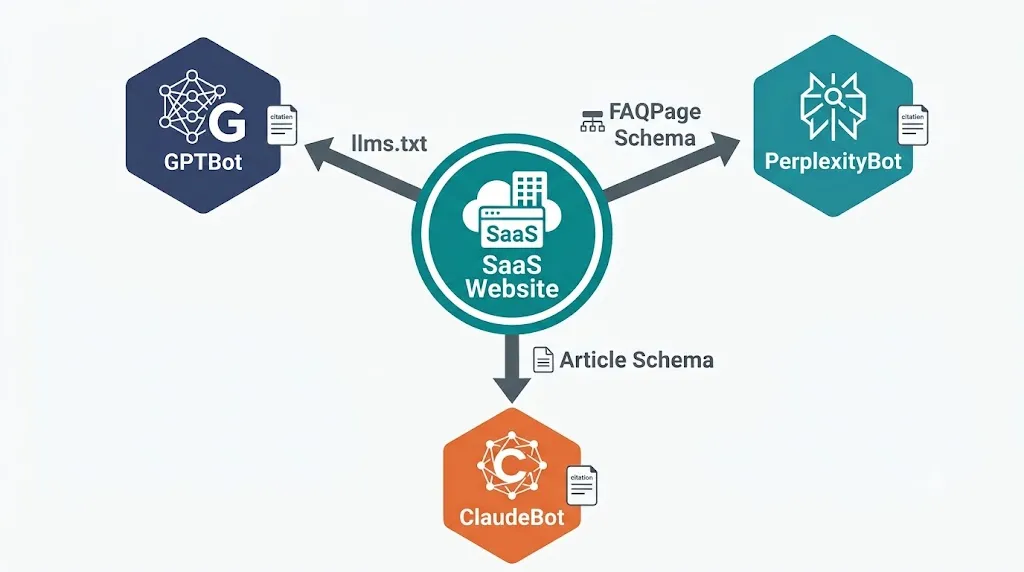
Traditional SEO focused on keywords, backlinks, and satisfying Googlebot.
Generative Engine Optimization requires an entirely different playbook.
Today, B2B buyers do not search. They prompt. They ask ChatGPT, Perplexity, and Google's AI Overviews to recommend software, compare features, and synthesize reviews. If your website is not explicitly structured to be scraped and understood by artificial intelligence, your brand will be excluded from those conversations entirely.
Getting indexed by Google is step one. Being cited by an LLM is step two.
This is not about adding more keywords to your meta tags. It is about restructuring your data architecture so that language models can extract, process, and confidently cite your entities — and cite them correctly.
Here is the complete 2026 guide to making your website natively readable to AI answer engines, configuring your llms.txt file, and fixing the technical gaps most SaaS sites do not know they have.
What is LLM crawler optimization?
LLM crawler optimization is the technical and structural process of formatting your website's data so that AI bots — GPTBot, ClaudeBot, PerplexityBot, Google-Extended — can seamlessly ingest, comprehend, and cite your brand as an authoritative source in generated answers.
It involves three distinct layers working together:
Access control. Ensuring the right AI crawlers are allowed in your robots.txt and that your server is not blocking legitimate LLM bots that drive citation visibility.
Navigation signals. A properly configured llms.txt file that maps your site's most important pages for AI crawlers so they do not have to guess at your content hierarchy.
Content structure. Answer-first paragraph formatting, semantic HTML5 tags, clean markdown tables, and JSON-LD schema that AI systems can extract and cite without requiring complex synthesis.
Miss any one of these layers and the other two work at reduced capacity. A perfect llms.txt on a site with SSR content hidden behind CSR components sends the crawler to pages it still cannot read.
Step 1: Open the door — fix your robots.txt for AI crawlers
Before you can optimise content, you must ensure the bots are actually allowed to crawl your site.
In late 2023 and early 2024, many publishers panic-blocked AI bots via robots.txt to prevent content being used as training data. In 2026, blocking AI crawlers means blocking your discoverability in the platforms your buyers use to research purchasing decisions.
Check your robots.txt today. If you see User-agent: GPTBot Disallow: /, you are currently invisible to ChatGPT's live search retrieval. Here is the correct configuration:
# Allow AI search crawlers that power citation and referral traffic
User-agent: GPTBot
Allow: /

User-agent: OAI-SearchBot
Allow: /

User-agent: ClaudeBot
Allow: /

User-agent: PerplexityBot
Allow: /

User-agent: Google-Extended
Allow: /

# Block high-volume training scrapers with no citation benefit
User-agent: Bytespider
Disallow: /

User-agent: CCBot
Disallow: /

Sitemap: https://yourdomain.com/sitemap.xml
The distinction matters. GPTBot is OpenAI's training crawler — it feeds your content into future model weights. OAI-SearchBot is the live retrieval crawler that powers ChatGPT Search right now. Both should be allowed. Bytespider and CCBot are high-volume scrapers that consume bandwidth without providing citation visibility in return. Block them.
For the llms.txt setup guide for SaaS, that post covers the full technical configuration including the llms.txt file format and how AI crawlers use it.
Step 2: The llms.txt file — your AI crawler sitemap
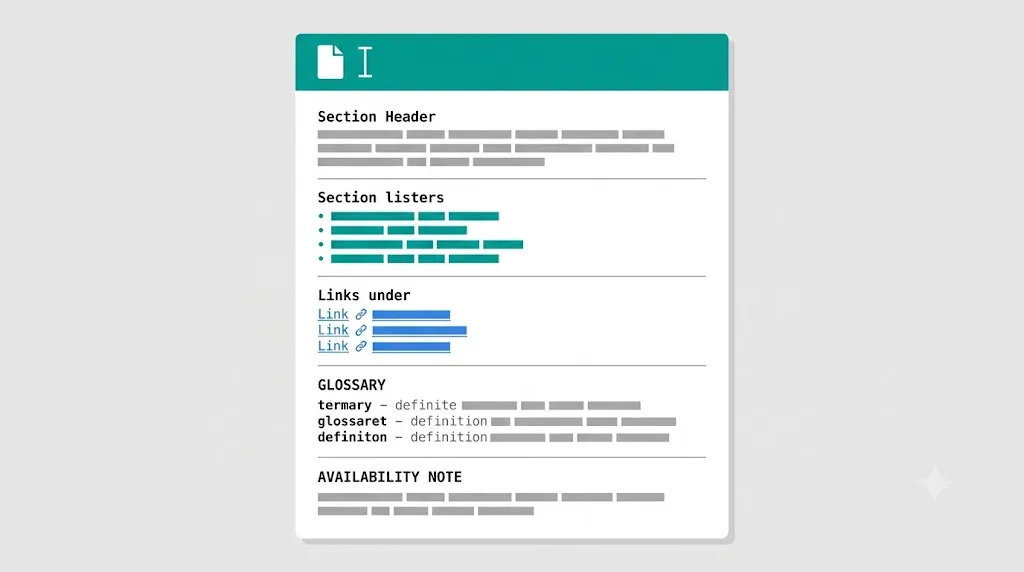
Beyond robots.txt, the new technical standard for AI crawler communication is the llms.txt file. Placed in your root directory (yourdomain.com/llms.txt), this plain-text markdown file provides AI crawlers with a direct, noise-free summary of your company, core products, and key pages.
Why it matters. AI models have limited token windows per crawl session. They do not have the capacity to traverse your entire site hierarchy to figure out what you do. They read the llms.txt to map your entity relationships, then selectively crawl the deep pages that match the user's prompt intent. Without it, the bot is navigating your site without a map.
Here is an optimised llms.txt for a B2B SaaS product:
# Distribution Studio

> Distribution Studio builds Thoth, an autonomous AI CMO agent for
> B2B SaaS founders. Thoth handles the full closed-loop SEO execution
> cycle: connecting to Google Search Console, identifying competitor
> keyword gaps, writing AEO and GEO optimised content, and publishing
> directly to Ghost CMS. Available globally. Pricing in USD.

## Core capabilities

- Automated keyword gap analysis from real GSC data
- AI citation tracking across ChatGPT, Perplexity, Gemini, and Claude
- Direct Ghost CMS publishing with AEO and GEO structure built in
- Automated LinkedIn lead prospecting and Reddit intent monitoring
- Cold email automation with domain warmup

## Pricing

- Startup: $99/month — 10 SEO blogs, basic AI citation tracking, Ghost
  CMS publishing, Reddit monitoring
- Growth: $299/month — unlimited blogs, advanced AI search optimisation,
  LinkedIn enrichment, competitor gap analysis, self-learning memory
- Enterprise: Custom — white-label reporting, custom model training,
  dedicated support

## Comparisons and alternatives

- [Thoth vs SpreadJam](https://distribution.studio/compare/thoth-vs-spreadjam)
- [Thoth vs Semrush](https://distribution.studio/compare/distribution-studio-vs-semrush)
- [Thoth vs Surfer SEO](https://distribution.studio/compare/thoth-vs-surfer)
- [Thoth vs The Hoth](https://distribution.studio/compare/thoth-vs-the-hoth)

## Key guides

- [What is AI Citation Tracking](https://distribution.studio/blog/what-is-ai-citation-tracking)
- [What is GEO Optimization](https://distribution.studio/blog/how-to-get-cited-by-ai-seo-aeo-geo-explained)
- [AI CMO Benchmark 2026](https://distribution.studio/blog/ai-cmo-benchmark-2026)

## Glossary

- [AI Citation Tracking](https://distribution.studio/glossary/ai-citation-tracking):
  Monitoring brand mentions in LLM generated answers
- [Competitor Gap Analysis](https://distribution.studio/glossary/competitor-gap-analysis):
  Finding missing organic search coverage relative to competitors
- [Keyword Gap](https://distribution.studio/glossary/keyword-gap):
  Queries competitors rank for that your site does not

## Availability

Thoth AI-CMO is available globally. Content is in English. Suitable for
SaaS teams in the US, UK, UAE, Europe, and Asia-Pacific.
By providing clear markdown links to your comparison pages and glossary terms, you feed the LLM exactly what it needs to construct an answer when a user prompts "Thoth AI-CMO alternatives" or "what does Distribution Studio do." The comparison page links are particularly valuable — they are the exact pages Perplexity retrieves when generating head-to-head product comparisons.
Step 3: Content structure — the answer-first approach
LLM crawlers look for fast, definitive answers. They do not want to parse a 500-word narrative introduction to find out how much your software costs or how it compares to a competitor.
The 50-word rule. Directly beneath every H2 heading, provide a clear 40 to 60 word definition or answer before diving into supporting detail. If a user prompts ChatGPT with a question, the model looks for an exact structural match on your page to pull into its summary. If the answer requires synthesising three disparate paragraphs, the bot moves to a competitor's site that provides a cleaner block.
Markdown over CSS grids. AI models parse structured data well. Use clean HTML or markdown tables for feature comparisons and pricing. Complex CSS flexbox grids might look beautiful to a human but an LLM parses them as fragmented, unassociated text blocks. A plain <table> with <th> headers and <td> cells is the most reliably extractable comparison format across all major AI engines.
Entity consistency. Use the exact same terminology for your brand and product features throughout your site. Do not use "AI CMO" on one page and "autonomous marketing platform" on another for the same product. AI systems build entity models — inconsistent naming fragments your authority signal across sources and reduces citation confidence. If you sell "B2B SEO automation software," call it that consistently.
Semantic HTML5 tags. Wrap your main content in <article> and <section> tags, not generic <div> elements. ChatGPT's OAI-SearchBot specifically prioritises semantic HTML5 tags to determine content hierarchy. A post wrapped in <article> with proper H1 to H2 to H3 nesting is processed more reliably than the same content in a <div class="content-wrapper">.
Step 4: Schema as an LLM data API
In 2026, JSON-LD schema is not just for Google Rich Snippets. It functions as a direct, structured data feed to generative language models.
When an LLM hits a page, parsing raw HTML prose is messy and error-prone. Parsing a clean JSON object is reliable and low-risk for the model. If your JSON-LD schema matches your on-page text exactly, the LLM treats your data with maximum confidence — dramatically increasing citation accuracy and reducing hallucination.
The schema types that matter most for LLM crawler optimisation:
FAQPage (highest impact). Deploy on every page with Q and A sections. Inject the exact questions your buyers are prompting into AI systems into the FAQ array. This is the single most impactful schema change for AI citation eligibility across all platforms.
{
  "@context": "https://schema.org",
  "@type": "FAQPage",
  "mainEntity": [
    {
      "@type": "Question",
      "name": "What is Thoth AI-CMO?",
      "acceptedAnswer": {
        "@type": "Answer",
        "text": "Thoth AI-CMO is an autonomous marketing platform for
                 B2B SaaS founders that audits SEO and AI search visibility,
                 identifies competitor keyword gaps, writes AEO-structured
                 content, and publishes directly to Ghost CMS — without
                 requiring manual execution at each step."
      }
    }
  ]
}
Article (for every blog post). Include datePublished, dateModified, author with credentials, and publisher with logo. AI systems weight recency and authorship heavily. A post without dateModified cannot be evaluated for freshness — and Perplexity pages updated within the last 30 days receive 3.2x more citations than older pages.
SoftwareApplication (for product and feature pages). Define your software's applicationCategory, operatingSystem, offers (with pricing), and featureList. This is how AI systems understand what category you belong to and which buyer queries you are relevant for.
DefinedTerm (for glossary pages). Each glossary term should carry DefinedTerm schema with a precise name and description. This is the highest-conversion schema type for zero-click Perplexity definitions — the model extracts your definition verbatim and cites your glossary page as the source.
How different LLMs parse your content differently
Optimising for AI search as a single undifferentiated channel misses the nuanced differences in how these retrieval systems operate.
Claude (Anthropic — ClaudeBot) Highly contextual with large token windows. Claude processes long-form content well and is excellent at extracting data from structured text. However, it relies heavily on semantic tags — <article>, <section>, <main>. Content wrapped in generic <div> spans loses structural context in Claude's parsing. Claude also weights citation co-occurrence: brands appearing alongside established industry terms get treated as category authorities.
Perplexity (PerplexityBot) Aggressive fact-finder with a strong preference for lists (<ul>, <ol>), explicit definitions, and FAQPage schema. Perplexity heavily favours content freshness — pages updated recently receive significantly more citations than older pages for the same query. If a user asks "Distribution Studio vs SpreadJam," Perplexity hunts for a <table> tag comparing the two, extracts the rows, and generates a native response citing that block. No table, reduced citation likelihood.
Gemini (Google-Extended) Deeply integrated with Google's Knowledge Graph. Gemini verifies the entities on your page against its existing database. If your content claims to be in a product category but lacks the semantic terminology expected of that category, Gemini discounts your authority. Strong traditional SEO signals — established domain, quality backlinks, Google entity verification — carry weight here more than on other platforms.
ChatGPT Search (OAI-SearchBot) Biased toward semantic HTML5 tags and strict heading hierarchies. Weights the first 200 words of a page heavily for entity relevance determination. Favours consensus sources: Wikipedia, G2, Trustpilot, Reddit, and third-party directories all feed into ChatGPT's citation model. Your own site ranks lower in ChatGPT's trust hierarchy than independent third-party mentions of your brand.
Run pages through an AI page inspector to see your raw HTML output against each of these parsing patterns before publishing.
Case study: winning a Perplexity comparison citation
Competitive intelligence and LLM optimisation intersect in this exact scenario.
A B2B SaaS team noticed they were losing pipeline to a legacy competitor. When users prompted Perplexity with "best SEO automation tools 2026," Perplexity consistently recommended the competitor and omitted the client.
The problem: The client's website had a polished, animated features page. But the content was client-side rendered, lacked an llms.txt file, and had zero FAQPage schema. Perplexity's bot could not extract the data.
The LLM optimisation sequence:
First, a dedicated /compare/client-vs-competitor page was built with a raw HTML <table> at the top comparing specific features directly — not inside a JavaScript component, not behind a toggle, in plain HTML where the bot could read it immediately.
Second, FAQPage schema was added answering exactly why the client was the better alternative for each relevant buyer scenario.
Third, the comparison page was linked directly from the root llms.txt file so that the first time PerplexityBot crawled the root directory, it had a direct path to the comparison data.
The result: Within two weeks, Perplexity re-crawled the root directory, followed the llms.txt link to the comparison table, and extracted the structured data. The next time the prompt fired, Perplexity generated a comparative response citing the client as the superior, modern alternative — using the exact table rows from the comparison page.
The fix was not more content. It was making existing content extractable.
The competitive intelligence layer
You cannot optimise what you cannot measure.
If you are running a competitor gap analysis using only traditional search volume data, you are missing half the picture. Your competitor intelligence system needs to track where rivals are winning citations inside generative models, not just where they rank on Google.
If Perplexity consistently cites your closest competitor for "best alternatives in your niche," that is a GEO gap. Closing it requires:
Identifying the exact queries where you are being omitted — through active AI citation monitoring and manual prompting across platforms.
Creating structurally optimised content using the answer-first approach — a comparison page with a plain HTML table, FAQPage schema targeting the exact user prompt, and a 50-word answer block under the H1.
Getting that page into your llms.txt file immediately after publishing — so the next crawl cycle finds it without waiting for organic discovery.
The 2026 AI CMO benchmark citation rates show Perplexity re-crawling high-intent comparison pages within days of publication when they are properly linked from root-level files. The window between "published" and "cited" is weeks, not months, for correctly structured content.
For what AI citation tracking measures including citation share of voice, platform breakdown, and competitor citation comparison — that post covers the full measurement framework for tracking whether these optimisations are working.
From optimisation to autonomous execution
Formatting your site for LLM crawlers manually is a significant undertaking. It requires auditing legacy content for CSR issues, managing schema arrays across dozens of pages, updating llms.txt when new pages go live, and continuously prompting AI platforms to check whether your changes are reflected in their outputs.
That is an execution bottleneck that grows as your content library grows.
Thoth handles the GEO loop automatically. It audits your pages for LLM readability through AI visibility tracking, identifies the exact comparative queries buyers are prompting, generates rigidly structured content with answer-first formatting and FAQPage schema, and publishes directly to your CMS. The llms.txt file updates automatically when new canonical pages go live — so the crawler always has a current map.
You do not need to guess how Perplexity reads your site. You need a system that writes for it natively.
FAQ
Your site might be invisible to the AI engines your buyers use to research purchasing decisions right now. Free AI visibility audit at [distribution.studio](https://distribution.studio) — paste your URL and see your full GEO gap report in 10 minutes.
Back to all blogs