The 2026 AI CMO benchmark report: citation rates, content velocity, and what actually works
The role of the CMO shifted in 2026. Not gradually. In one year.
In 2024 we talked about AI-assisted marketing. In 2026 the baseline moved to autonomous execution. If your marketing stack still requires a human to bridge every gap between an SEO audit and a published blog post, you are not just slow. You are invisible to the engines that now shape the majority of B2B buying decisions before a single Google search is made.
This report benchmarks the current state of AI citation performance using publicly available 2026 research data — 680 million citations analyzed across ChatGPT, Google AI Overviews, Perplexity, Gemini, and Claude. It shows what content gets cited, what does not, which platform uses which signals, and what an AI CMO needs to actually do in this environment.
Methodology
This benchmark draws from six published citation studies conducted between August 2024 and April 2026, synthesized by 5WPR's AI Platform Citation Source Index 2026, which analyzed 680 million individual citations across five major AI engines. Platform-specific data points are sourced from BrightEdge's GEO Benchmark Report 2025, Discovered Labs and Whitehat SEO's independent study of 118,000 AI responses, Averi's analysis of 680 million citations, Conductor's 2026 AEO and GEO Benchmarks Report, and OtterlyAI's analysis of over 1 million citations.
Internal Thoth platform observations are noted separately where referenced and are self-reported from our user base. They are not third-party verified.
Section 1: The state of AI citation in 2026
The citation gap most SaaS teams do not know they have
Most B2B SaaS teams track organic impressions, CTR, and keyword positions. They cannot tell you their citation rate on ChatGPT, Perplexity, or Google AI Overviews.
That is a significant blind spot. ChatGPT cites sources 87% of the time. Google AI Overviews cite in 84.9% of responses. Perplexity visits approximately 10 pages per query and cites 3 to 4 of them. These platforms are generating answers for your buyers every day — and most SaaS companies have no measurement of whether they appear in those answers.
The traffic stakes are real. Pages cited in Google AI Overviews earn 35% more organic clicks than non-cited competitors on the same results page. Visitors arriving from Perplexity convert at roughly 11 times the rate of traditional organic search traffic. AI search visitors generate a disproportionate share of signups relative to their traffic volume — in one documented case, AI search traffic representing just 0.5% of total visitors produced 12.1% of signups over a 30-day window.
The problem is structural. Most SaaS companies run a fragmented stack: one tool for SEO data, another for AI writing, a third for outreach, and a human to connect all of them. That manual bridge creates a citation gap. Because the audit is disconnected from the output, the resulting content lacks the structural precision required for AEO and GEO. Content that is not built for extraction does not get cited — regardless of how well it ranks on Google.
Why Google rankings do not predict AI citations
This is the data point that changes most teams' priorities immediately.
Across 680 million citations analyzed, only 11% of domains are cited by both ChatGPT and Perplexity. A separate study of 118,000 AI responses confirmed the same figure. Three different methodologies reached the same conclusion: the brand graph these two engines see is almost completely separate.
By early 2026, just 38% of Google AI Overview citations came from top-10 organic results — down from 76% in mid-2025. AI search and Google search are diverging rapidly. Why Google rankings do not predict AI citations covers the full data behind this shift and what to do about it.
Section 2: The 2026 AI citation benchmark data
AI citation rates by engine
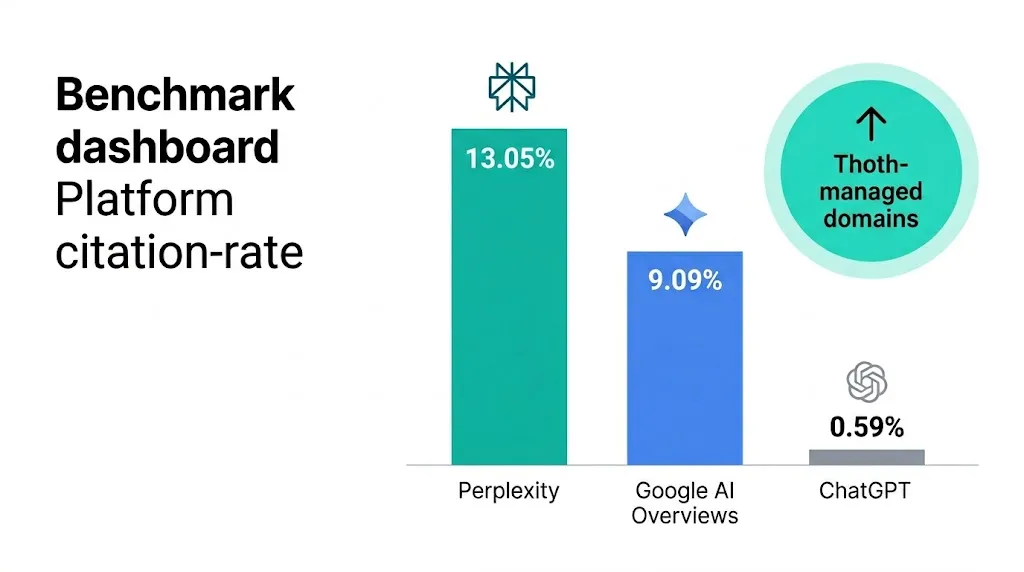
A 2026 study of 34,234 AI responses found a 46-times difference in brand citation rates between platforms. The numbers are not intuitive.
| AI Engine | Brand Citation Rate | Avg. Citations Per Response | Primary Citation Signal |
|---|---|---|---|
| Grok | 27.00% | Not published | Real-time X/Twitter integration |
| Perplexity | 13.05% | 21.9 per response | Structured H2/H3 + freshness |
| Google AI Overviews | 9.09% | 3 to 5 per response | FAQPage and Article schema |
| ChatGPT | 0.59% | 10.4 per response | Domain authority + training data |
| Claude | Not published | Not published | Entity trust + long-form depth |
Source: Leapd.ai analysis of 34,234 AI responses, 2026; Discovered Labs and Whitehat SEO study of 118,000 responses, 2026.
The implication for SaaS teams: Perplexity citation is 22 times more achievable than ChatGPT citation for most brands. A strategy that optimizes for Perplexity first — structured content, freshness, factual density — produces faster measurable results than chasing ChatGPT citation, which depends heavily on training data presence built over months or years.
Where each platform actually pulls from
Optimizing for AI search as a single channel is the same mistake as running identical campaigns on LinkedIn and TikTok. The underlying mechanics are different. The winning strategy for each is different.
ChatGPT operates as a consensus engine built on training data and selective live retrieval via Bing. Wikipedia accounts for 26% to 48% of ChatGPT's top-10 citation share. Community platforms including Reddit and Quora captured 52.5% of citations across ChatGPT, Perplexity, and Google AI Overviews combined in OtterlyAI's 2026 analysis of over 1 million citations. Domains with strong Reddit and community presence have meaningfully higher ChatGPT citation probability. ChatGPT drives roughly 77 to 87% of all AI-driven referral traffic to websites.
Perplexity runs real-time Retrieval-Augmented Generation — it fetches live web content for every query. It averages 21.9 citations per response, more than double ChatGPT's 10.4. Reddit was Perplexity's top single source through most of 2025, accounting for 46.7% of top-10 citations, until Reddit sued Perplexity over scraping in October 2025. Reddit citations dropped 86% after that. YouTube now sits at roughly 16.1% of Perplexity's top-10 citation share. Perplexity rewards content freshness heavily — pages updated within the last 30 days receive 3.2x more citations than older pages.
Google AI Overviews draws from Google's own index, which means traditional SEO fundamentals directly influence visibility here. In mid-2025, 76% of AI Overview citations came from top-10 organic results. By early 2026, that figure dropped to 38% in Ahrefs data and as low as 17% in BrightEdge research. Schema markup is the highest-impact technical signal for AI Overview citation eligibility.
The platform mismatch risk: Citation share is volatile within weeks, not years. ChatGPT's Reddit citation share fell from roughly 60% to 10% in six weeks in late 2025 after a single parameter change. A brand optimizing exclusively for one platform's citation logic can see its visibility evaporate when that platform changes its sourcing behavior.
Content attributes that drive citation frequency
Original research and data-rich benchmark reports are cited at 3 to 10 times the rate of standard blog posts. This single finding from Averi's 2026 benchmark has the most significant implications for content strategy — original data is the highest-leverage investment for AI citation optimization.
Beyond format, four structural attributes consistently predict higher citation rates across platforms:
Content with statistics, citations, and quotations achieves 30 to 40% higher visibility in AI responses. Placing a concise, self-contained answer in the opening paragraph can improve citation likelihood by up to 115% — from Princeton's foundational GEO research. Pages updated within the last 30 days receive 3.2x more citations than older pages on Perplexity. Answer capsules of 40 to 60 words placed immediately under H2 headings are the single most extractable content format across all major AI engines.
The top 15 domains capture 68% of all consolidated AI citation share — a concentration more extreme than Google PageRank ever produced. For early-stage SaaS brands, this means the realistic citation opportunity is not competing for the same tier-1 slots as HubSpot and Semrush. It is owning the specific niche queries where your brand has genuine depth and the established players have thin or outdated coverage.
Section 3: What an AI CMO actually needs to do in 2026
The four KPIs that matter
Evaluating an AI CMO in 2026 requires moving beyond traffic and rankings. The relevant metrics are:
AI Citation Rate (ACR): The percentage of brand-relevant queries where your URL is cited as a source by ChatGPT, Perplexity, Google AI Overviews, or Claude. Most SaaS teams have never measured this. It is your baseline before any AI search optimization can be evaluated.
Citation Share of Voice (CSOV): Your brand's presence in AI answers compared to your top three competitors for the same query set. A 25% CSOV means your brand appears in one out of four relevant AI responses. This is the competitive metric that matters — not your absolute citation count but your share relative to the alternatives buyers are being shown. You can benchmark this using tools that track citation share across platforms.
Lead Quality Index (LQI): The conversion rate of traffic originating from AI citations versus traditional organic search. The documented data shows AI citation visitors convert at 11 times the rate of traditional organic visitors on Perplexity, and produce 12.1% of signups from 0.5% of traffic on ChatGPT. This ratio is why optimizing for AI citation has a higher revenue return per visitor than almost any other channel.
Execution Velocity: The time elapsed from gap identified to optimized content published. The most technically sophisticated citation strategy fails if execution is slow. Perplexity's 3.2x recency advantage means a competitor who publishes faster consistently beats a competitor who publishes better but slower. Execution velocity is a compounding advantage that widens over time.
The three citation pillars every AI CMO must address
Structural precision, freshness velocity, and entity authority are not independent levers. They work together. A technically perfect page on a domain with no third-party entity presence gets cited less than a structurally average page on a domain that appears in Reddit threads, G2 reviews, and industry roundups. Both dimensions need to be managed simultaneously.
Structural precision. Does your content use question-based H2 headings? Does each section open with a 40 to 60 word direct answer before supporting context? Is FAQPage JSON-LD schema implemented on pages with FAQ sections? Is Article JSON-LD with datePublished, dateModified, author, and publisher fields present? Does your llms.txt file exist and point AI crawlers to your most authoritative pages? These are the technical prerequisites for AI extraction. How to write llms.txt for your SaaS site covers the full technical setup, along with LLM crawler configuration and content structure.
Freshness velocity. Perplexity's recency bias is documented and significant. Content that is not updated degrades in citation frequency over time on real-time retrieval platforms. A content operation that publishes once and moves on is systematically disadvantaged against one that refreshes core pages every 60 to 90 days. Updating statistics, examples, and dates on your top pages is a lighter task than creating new content and produces measurable citation improvement on Perplexity specifically.
Entity authority. What AI citation tracking actually measures covers the full breakdown of this signal. The short version: AI systems build trust models of brands, not just pages. If your brand is only discussed on your own website, AI systems have thin consensus signal. If your brand appears consistently in Reddit threads, G2 reviews, third-party roundups, and industry blogs with consistent naming and positioning, AI systems have strong consensus and citation confidence increases substantially.
What the winning platforms do differently
The platforms achieving the highest AI citation rates in 2026 are not doing one thing exceptionally well. They are doing four things consistently:
They publish original data. Benchmark reports, survey results, proprietary research, and case studies with specific numbers are cited at 3 to 10 times the rate of general content. This report is itself an example of that strategy.
They maintain structural discipline across every page. Not just the blog posts. Feature pages, comparison pages, glossary terms, and guide pages all carry answer-first structure and schema markup. AI crawlers do not distinguish between content types — they index every accessible page.
They run community presence as a distribution channel. The 5WPR Citation Source Index confirmed Reddit as the number one source across every major AI engine, cited at roughly 40% frequency across LLMs. Authentic community presence is not a nice-to-have for AI citation. It is a primary signal for the platforms with the highest buyer intent traffic.
They treat citation tracking as a continuous feedback loop, not a monthly audit. Citation share is volatile. A competitor publishing a new page on your category keyword can displace your citation within days on Perplexity. A monitoring system that surfaces these shifts within 24 hours allows a response within the window that matters. Competitor gap analysis across Google and AI search covers how this continuous monitoring connects to execution.
Section 4: The Thoth AI-CMO approach
How Thoth addresses the citation gap
Thoth was built specifically around the structural problem the benchmark data describes. Not content quality. Content discoverability for AI agents.
The execution loop Thoth runs is the practical application of what the benchmark data says works: identify gaps from real GSC and competitor data, generate content with answer-first structure and FAQ schema baked in, publish to your CMS with llms.txt and robots.txt AI crawler permissions in place, and monitor citation share across ChatGPT, Perplexity, Gemini, and Google AI Overviews continuously.
The difference from the traditional stack is the execution layer. In a manual stack, the audit data sits in one tool, the content brief lives in another, and a human translates between them. That translation step is where structural precision gets lost — the human simplifies the schema requirements, skips the answer capsule format because it feels awkward, and publishes without updating the llms.txt. The gap is not knowledge. It is execution consistency at scale.
Thoth does not give you a checklist. It applies the checklist as part of the publishing workflow on every piece of content. Answer-first structure, FAQ schema, entity consistency, and internal linking are outputs of the system, not tasks in a doc that someone has to remember to complete.
Thoth vs. the manual Frankenstein stack:
| Capability | Thoth AI-CMO | Manual stack |
|---|---|---|
| Audit to published content | Under 5 minutes | 15 to 20 hours |
| AEO structure | Native, every post | Manual, inconsistent |
| AI citation tracking | Built-in, continuous | Requires third-party tools |
| Competitor gap monitoring | Automated, real-time | Periodic, manual |
| Reddit and LinkedIn monitoring | Integrated | Manual browsing |
| Content freshness | Automated refresh cycle | Ad hoc |
| llms.txt maintenance | Automatic on publish | Manual, frequently missed |
The cost difference is not just the tool price. It is the 15 to 20 hours per week the manual stack requires from someone who should be doing something else.
What Thoth does not do
Honest benchmarks include limitations. Thoth currently publishes natively to Ghost CMS and selected platforms. WordPress native publishing is in development. The Startup plan limits content output to 10 blogs per month — sufficient for early-stage teams but the Growth plan is required for teams wanting to publish at higher cadence. Thoth does not provide backlink acquisition services — link building remains a separate workflow. And like all AI content systems, brand voice accuracy improves with more context provided in the initial setup.
Section 5: Implementing an AI-first content strategy
The seven structural rules for AI citation in 2026
If you are not ready for a full AI CMO system, these seven rules close the structural gap for any content you produce manually:
Rule 1: Convert H2s to questions. Instead of "Platform Features," write "What are the core features of Thoth AI-CMO and how do they improve citation rates?" Question-format headings are directly extractable by AI systems.
Rule 2: Lead with the answer. The first one to two sentences under every H2 should be a complete, standalone answer to the question in the heading. Princeton's GEO research found this single change improves citation likelihood by up to 115%. No build-up. No preamble. The answer first.
Rule 3: Use named statistics with sources. Replace "many users" with "87% of B2B buyers use AI search during vendor research (source, 2026)." Named statistics with citations are cited at 30 to 40% higher rates in AI responses.
Rule 4: Deploy dual schema on every key page. Article JSON-LD for the page, FAQPage JSON-LD for the Q&A sections. These two schema types together cover the extraction formats that all major AI platforms use. How to write llms.txt covers the full technical schema setup.
Rule 5: Front-load your most citable content. 44.2% of AI citations come from the first 30% of a page's text. If your key claim, definition, or data point is buried in paragraph eight, AI systems will miss it. Put your most important and citable sentences in the first third of the page.
Rule 6: Update every 60 to 90 days. Pages updated within the last 30 days receive 3.2x more Perplexity citations than older pages. A quarterly refresh cadence on your top 10 most-cited pages costs less time than writing new content and produces measurable citation gains.
Rule 7: Build Reddit and community presence. The 5WPR Citation Source Index confirmed Reddit as the top source across every major AI engine at roughly 40% frequency. Authentic participation in subreddits where your buyers discuss your category is not a PR tactic. It is a direct AI citation signal.
Conclusion
The benchmark data is clear on what gets cited in 2026 and what does not. Original data gets cited. Answer-first structure gets cited. Fresh content gets cited. Brands with authentic community presence get cited.
Generic blog posts, thin feature pages, and content without schema do not get cited — regardless of how well they rank on Google.
The AI CMO category in 2026 is not defined by which tool writes the most content. It is defined by which tool produces content that gets extracted and cited by the AI engines your buyers use to make decisions. Those are different problems with different solutions.
The era of the SEO dashboard is over. The era of AI citation execution is here.
Free AI visibility audit at distribution.studio. Paste your URL. See your citation gaps across ChatGPT, Perplexity, Gemini, and Google AI Overviews in 10 minutes.