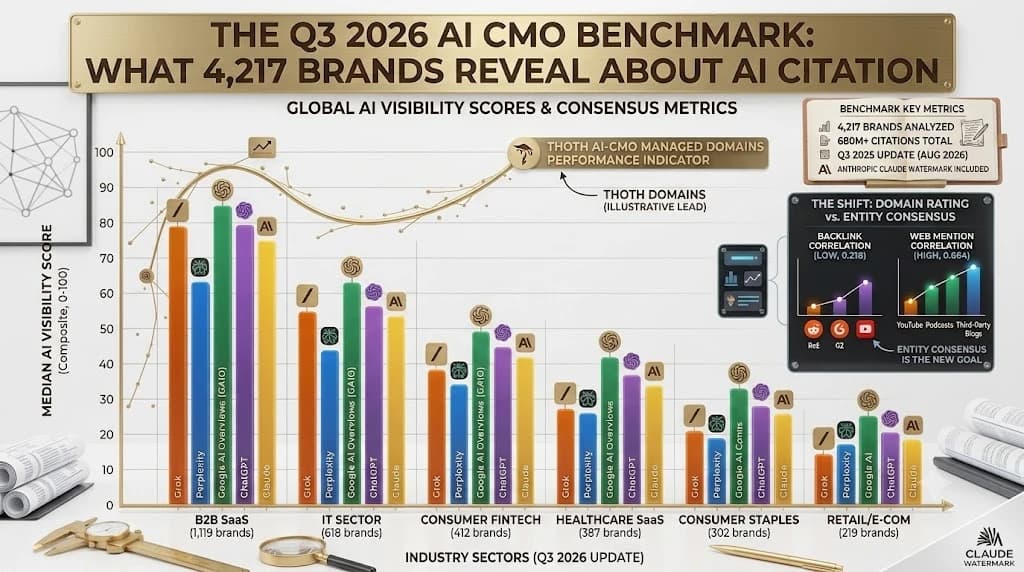
The Q3 2026 AI CMO benchmark: what 4,217 brands reveal about AI citation in the second half
The first benchmark we published in June drew from 680 million citations across the H1 2026 dataset. The picture that data painted was directional: Perplexity citation was more achievable than ChatGPT, original research earned citations at significantly higher rates than standard content, and the top 15 domains were capturing 68% of consolidated AI citation share.
Q3 data tells a more specific story. And in several places, it contradicts the conventional wisdom that has built up around GEO optimization.
This report synthesizes four new studies published between April and August 2026: Foglift's Q2 AI Search Citation Benchmark covering 1,119 distinct cited domains across 375 buyer-intent responses, Foglift's separate Q2 AEO Readiness study of 1,386 scans across 344 domains, MaximusLabs' analysis of 200+ B2B SaaS and AI companies across five AI platforms, Conductor's 2026 AEO/GEO Benchmarks Report drawing from 3.3 billion sessions and 21.9 million analyzed queries, and AirOps' April 2026 study on citation lift by content type for ChatGPT specifically.
It also incorporates the most significant platform development since our H1 report: Anthropic's August 2, 2026 deployment of statistical watermarks in all Claude-generated text — and what that means for AI content strategies at scale.
Methodology
This report synthesizes published primary research from the sources listed above. All specific data points are attributed to their source. Internal Thoth platform observations are noted separately and are self-reported from our user base — not third-party verified.
For the H1 2026 baseline covering 680 million citations, see the H1 2026 AI CMO benchmark.
Section 1: The platform landscape has shifted significantly since June
ChatGPT reaches 1 billion monthly users — but citation share is consolidating
ChatGPT passed 900 million weekly active users in early 2026, up from 400 million in February 2025. By June 2026, Reuters reported the app had reached 1 billion monthly active users, making it the fastest app in history to reach that milestone. ChatGPT now processes roughly 2.5 billion prompts per day.
The scale of the platform is not in dispute. The citation dynamics are more nuanced than the traffic numbers suggest.
Conductor's 2026 AEO/GEO Benchmarks Report, analyzing 3.3 billion sessions and 21.9 million queries, found Google AI Overviews appear in 25.11% of all searches — and ChatGPT delivers 87.4% of all AI referral traffic.
That second number deserves attention. ChatGPT drives the vast majority of AI referral traffic to websites despite having a lower brand citation rate than Perplexity. The implication: citation volume matters more than citation rate when ChatGPT is involved, because the traffic it sends — when it does send it — is significantly larger in absolute terms.
Foglift's Q2 2026 AI Search Citation Benchmark found 1,119 distinct cited domains across 375 buyer-intent responses, with 61.7% of top-25 domains appearing in exactly one engine's top-25 list.
This confirms and sharpens the H1 finding: most domains are cited by one AI platform, not several. Cross-platform citation remains the exception. A strategy targeting Perplexity citation specifically will produce a different result than one targeting ChatGPT citation — and optimizing for both requires treating them as separate channels with different content requirements.
Google AI Mode crosses 1 billion users — and changes the AIO dynamic
Google announced at I/O 2026 that AI Mode, its fully generative search interface, surpassed 1 billion monthly users, with query volume more than doubling each quarter. This is a different product from Google AI Overviews, which appear as summaries within traditional search results.
The distinction matters for benchmark data. Clickstream data from January through April 2026 showed AI Mode at just 0.34% of all Google searches during that window, meaning the behavioural impact of AI Mode has barely begun. The user count is large. The actual share of search queries being processed through AI Mode is still small. The trajectory, however, is clear.
For content strategists, this creates an asymmetric opportunity. Google AI Mode citation is less competitive now than it will be in six to twelve months, because most brands have not yet structured their content for the AI Mode extraction pattern — which differs from traditional AI Overviews in favoring longer, more complex responses with more cited sources per answer.
The AEO readiness gap is wider than most teams realize
Foglift's Q2 2026 AEO Readiness study analyzed 1,386 scans across 344 broader-market domains. Domains with full AEO scoring had a median AI Readiness Score of 46/100 versus a median SEO score of 86/100, and 44.5% of SEO-strong domains still scored below 50 on AEO.
This single finding reframes the urgency for most SaaS content teams. The median domain in the study ranks competitively on traditional search — 86/100 SEO score — but scores below passing on AI citation readiness. Nearly half of SEO-strong domains are effectively invisible to AI extraction despite ranking well on Google.
70% of marketers believe AEO will significantly impact their strategy within 1 to 3 years, but only 20% have begun implementing it. The implementation gap creates the window. The brands optimising for AI citation now are building a structural advantage against competitors who are waiting for the category to mature before they act.
Section 2: New data on what actually drives citations in Q3
FAQ content is the single highest-impact structural element
Pages with well-structured FAQ sections are 2.8x more likely to be cited in AI answers than pages without. This is consistent with the H1 data and strengthens the finding with a larger Q2 sample. FAQPage schema is not a nice-to-have — it is the single structural change with the most documented citation impact across multiple independent studies.
The mechanism is direct. AI systems look for explicitly formatted Q and A pairs because they mirror the query-and-response structure of a conversational AI interaction. A page that asks "What is a keyword gap in SEO?" and answers it in two clean sentences under that heading provides the exact extraction format the model needs. A page with the same information buried in a narrative paragraph does not.
Comparison pages with three tables earn 25.7% more ChatGPT citations
AirOps published a study in April 2026: comparison pages with three tables receive 25.7% more AI citations, validation pages with eight list sections up to 26.9% more, and shortlist pages averaging ten words or fewer per sentence 18.8% more. The figures apply per page type and exclusively to ChatGPT — they do not transfer to other platforms.
This is the most granular citation lift data published in 2026 and it carries an important qualifier: the percentage lifts are ChatGPT-specific. The structural elements that drive ChatGPT citation — comparison tables, validation lists, short sentences — are not identical to what drives Perplexity or Gemini citation.
For Thoth's content publishing workflow, this informs the page type template for each use case. Comparison pages against competitors get three tables minimum. Validation and social proof pages get eight or more list sections. Shortlist and best-of pages target an average of ten words or fewer per sentence in the body copy. The schema and structure adapt to the content type, not just the platform.
Entity authority is now the strongest single predictor of AI citation
MaximusLabs analyzed 200+ B2B SaaS and AI companies ranked across ChatGPT, Perplexity, Gemini, and Google AI Overviews. Brands that establish strong citation rates today are building the training data advantage that will make them progressively harder to displace as models mature.
The compounding nature of entity authority is the most strategically significant finding in the Q3 data. Early citation builds training data presence. Training data presence makes future citations more likely. The brands acting in H2 2026 are not just gaining citation share now — they are compressing a structural advantage that becomes harder to close as AI model training cycles continue.
The working framework for $5M to $100M ARR companies: 60% traditional SEO plus 40% GEO/AEO in budget allocation. For earlier-stage companies, the implication is different — the citation baseline has to be built before the budget exists to sustain the 40/60 split. Starting now with whatever content budget exists is categorically better than waiting until the company can "properly fund" GEO investment.
Brand web mentions outperform backlinks for AI Overview visibility
Ahrefs analyzed 75,000 brands for AI Overview visibility factors. Brand web mentions showed a correlation of 0.664, brand anchors 0.527, brand search volume 0.392, backlinks 0.218. Ahrefs stresses that correlation does not establish causation and every factor shows moderate to very weak relationships on the Spearman scale.
Despite the appropriate caveat on correlation, the ordering of these signals is directionally useful. Brand web mentions — the total number of times your brand name appears across the web, with or without a link — show the strongest association with AI Overview visibility among the factors tested. This is consistent with the H1 finding on entity authority. AI systems are building consensus models of brand relevance, and mentions feed that model more directly than link graph signals do.
The practical implication: PR placements, authentic community mentions, podcast appearances, and directory listings all contribute to AI visibility in ways that traditional link-focused SEO measurement misses. The best AI citation tracking tools in 2026 covers how to measure unlinked brand mention frequency across platforms.
Section 3: The August 2026 Claude watermark — what it means for AI content at scale
The most significant platform development since the H1 report is Anthropic's August 2, 2026 deployment of statistical watermarks in all Claude-generated text.
The watermark is a machine-readable statistical pattern embedded into Claude's token and word choices during generation — not in metadata. It applies globally to all Claude models launched from August 2 onwards, across every Claude surface including the API, Claude.ai, Claude Code, and Claude Cowork. The watermark travels with copied text and may survive light editing.
For content teams using Claude to generate marketing copy, blog posts, or product descriptions at scale, this creates a new compliance and detection surface:
EU AI Act compliance. Article 50 of the EU AI Act requires machine-readable marking of AI-generated text. Anthropic applied the watermark globally because it has no durable mechanism to scope it by region. Content generated through Claude after August 2 carries this mark whether the brand operates in the EU or not.
Detection risk. Anthropic is developing a public detection API. Once available, third parties — publishers, clients, distributors — will be able to verify whether content was generated or processed by Claude. For agencies producing AI-generated content without disclosure, this creates material risk.
The proofreading problem. Anthropic has confirmed that human-written text sent to Claude for proofreading, translation, or formatting will carry the watermark in the returned output — even though the original content was human- written. Teams using Claude for editorial polish on human-written drafts need to account for this.
For the full technical breakdown of what each AI provider is doing on watermarking, see AI writing watermarks and what Claude's August 2026 update means. Thoth's content generation pipeline does not run through Claude's generation API — Thoth output does not carry the August 2026 Claude statistical watermark.
Section 4: The updated citation benchmarks table
Combining H1 data with Q3 findings and updated platform metrics:
| AI Platform | Brand Citation Rate | Citations Per Response | AI Referral Traffic Share | Primary Citation Signal |
|---|---|---|---|---|
| Grok | 27.00% | Not published | Not measured | Real-time X/Twitter |
| Perplexity | 13.05% | 21.9 | 8 to 12% of AI referral | Freshness + structure |
| Google AI Overviews | 9.09% | 3 to 5 | Integrated with organic | FAQPage schema + top 10 |
| Google AI Mode | Emerging | Higher than AIO | Growing, 0.34% of searches | Long-form + multiple sources |
| ChatGPT | 0.59% | 10.4 | 87.4% of AI referral | Training data + Bing index |
| Claude | Not published | Not published | Not measured | Entity trust + C2PA files |
Source: Leapd.ai, 2026; Conductor 2026 AEO/GEO Benchmarks Report; Foglift Q2 2026; 5WPR Citation Source Index 2026; Discovered Labs/Whitehat SEO 2026.
The ChatGPT referral traffic share — 87.4% of all AI-driven referral traffic — is the most operationally significant number in this table for revenue teams. Perplexity has a higher brand citation rate but ChatGPT drives the traffic. A complete AI CMO strategy requires both: Perplexity optimisation for citation frequency and ChatGPT optimisation for referral volume.
Section 5: Industry benchmarks — where SaaS stands
Foglift's Q1 2026 aggregate benchmark dataset evaluated 4,217 brands with 150 or more industry-specific prompts across ChatGPT, Perplexity, Claude, and Google AI Overviews. SaaS brands lead the pack because their content-heavy marketing and strong domain authority translate well to AI visibility.
Conductor's analysis found AI referral traffic accounts for 1.08% of all website traffic for ten key industries. The IT sector (2.8%) and Consumer Staples (1.9%) had the highest percentage of their total traffic coming from AI referrals. On average, AI referral traffic is growing around 1% month-over-month.
For B2B SaaS specifically, the 1% monthly growth rate in AI referral traffic compounds significantly over twelve months. A content operation that earns 2% of traffic from AI citations today will, at that growth rate, see AI referrals approach 25% of total organic traffic by mid-2027 without any additional optimisation effort — simply from platform growth.
The brands that establish citation presence now inherit that compound growth. The brands that wait inherit a competitive landscape where citation share is already consolidating around early movers.
37% of agencies that increased prices in 2025 to 2026 cited GEO and AEO services as the primary reason, with AI search optimization often priced separately. The service category is maturing and pricing is separating from traditional SEO. For SaaS brands evaluating whether to build internal GEO capability or outsource it, the window of competitive differentiation through early investment is narrowing.
Section 6: The revised seven rules — what changed from H1
The seven structural rules from the H1 benchmark remain valid. Three updates are warranted based on Q3 data.
Rule 1 (updated): FAQ schema is now mandatory, not recommended. The H1 data showed FAQ-structured pages outperformed unstructured pages. The Q2 data from Foglift confirms pages with well-structured FAQ sections are 2.8x more likely to be cited. This moves FAQ schema from a high-impact recommendation to a baseline requirement for any page targeting AI citation.
Rule 4 (updated): Add SoftwareApplication schema to all product pages. H1 focused on Article and FAQPage schema. Q3 data on Google AI Mode — which favors longer responses with more cited sources — suggests SoftwareApplication schema on feature and product pages increases citation eligibility specifically for evaluation-stage queries. This applies to /features/, /integrations/, and /compare/ pages specifically.
Rule 8 (new): Structure comparison pages with exactly three tables. AirOps' finding that comparison pages with three tables earn 25.7% more ChatGPT citations is specific enough to act on directly. Pages at /compare/thoth-vs-[competitor] should have at minimum: a feature comparison table, a pricing comparison table, and a use-case suitability table. Not one consolidated table — three distinct tables that ChatGPT can extract independently.
The remaining four rules from H1 — answer-first structure, named statistics, front-loaded key content, 60 to 90 day refresh cadence, and community presence — are unchanged and remain the highest-impact levers for AI citation across all platforms.
Section 7: The Thoth approach in Q3
The H1 benchmark described what Thoth does structurally. Q3 warrants an update on two specific points.
The Claude watermark change. Thoth's content generation pipeline does not route through Claude's generation API. Thoth output does not carry the August 2026 Claude statistical watermark. For content teams concerned about the EU AI Act compliance implications of Claude-generated marketing copy, Thoth's pipeline is separate from this regulatory surface.
The comparison page update. Based on AirOps' three-table finding, Thoth's comparison page template has been updated to produce three distinct tables per comparison: features, pricing, and use-case fit. Every /compare/ page published through Thoth after August 2026 follows this structure.
The AEO readiness gap. Foglift's finding that 44.5% of SEO-strong domains score below 50 on AEO readiness confirms the execution problem the H1 benchmark identified: most teams know what to do but are not doing it consistently across their content library. Thoth applies answer-first structure, FAQ schema, and entity consistency as outputs of the publishing workflow — not as a checklist to remember — which is why AEO readiness improves across the full content library rather than just on newly published pages.
The updated Thoth vs manual stack comparison:
| Capability | Thoth AI-CMO | Manual stack |
|---|---|---|
| FAQ schema on every page | Automatic | Inconsistent |
| Three-table comparison page structure | Template applied on publish | Requires per-page implementation |
| Article schema with dateModified | Automatic on every refresh | Manual, frequently missed |
| SoftwareApplication schema on product pages | Applied from Q3 2026 | Requires developer coordination |
| llms.txt updated on new page publish | Automatic | Manual, frequently stale |
| Claude watermark | Not present — separate pipeline | Present if using Claude directly |
| AEO readiness score (Foglift scale) | Targeting 70+ across library | Median 46/100 across industry |
Conclusion: what the second half of 2026 requires
The H1 benchmark established that AI citation is a different game from Google SEO and requires a different strategy. The Q3 data adds precision.
FAQ structure is not optional. Three-table comparison pages outperform two-table or one-table versions on ChatGPT specifically. The AEO readiness gap between SEO-strong and AI-citation-ready is wider than most teams assumed — 86/100 SEO score versus 46/100 AEO readiness score as a median. The brands building entity authority now are compressing a structural advantage that will harden as model training cycles continue.
The Claude watermark development adds a compliance dimension that did not exist in H1. Content teams using Claude directly for marketing copy at scale need to account for both the EU AI Act implications and the detection risk as Anthropic's detection API becomes publicly available.
Being cited is the new page one ranking. The metric that matters is inclusion, not just traffic — because AI citations shape buyer perception even when no click occurs, and 90% of higher-intent buyers still click through to at least one cited source in an AI answer.
The brands that build citation presence in H2 2026 inherit the compound growth of a channel that is adding 1% month-over-month to AI referral traffic share. The brands that wait will enter a more consolidated landscape.
Free AI visibility audit at distribution.studio. See your citation gaps across ChatGPT, Perplexity, Gemini, Google AI Overviews, and Claude in 10 minutes.