How to automate SEO: the 2026 playbook for SaaS founders
Most founders try to automate SEO by buying another tool.
Semrush for the data. Surfer for the brief. Jasper for the writing. Zapier to connect them. A spreadsheet to track what went where. Then a human to sit in the middle of all of it, interpreting one tool's output as another tool's input.
That is not SEO automation. That is a more expensive version of manual SEO with extra steps between the steps.
The actual problem with SEO at founder scale is not the tools. It is the handoffs. The gap between the audit and the brief. Between the brief and the published post. Between the published post and any measurement of whether it moved. Each handoff requires a human decision, a context switch, and time that a founder doing four other jobs does not have.
Automating SEO means eliminating the handoffs — not adding more tools into the same fragmented workflow. Here is exactly how to do it.
What SEO automation actually means in 2026
SEO automation is the use of software and AI to execute repetitive search optimisation tasks — site audits, keyword tracking, rank monitoring, content brief generation, schema updates, and publishing — without manual intervention at each step.
The key phrase is "without manual intervention at each step." Not "faster manual SEO." Not "AI writing that still needs a brief from a human." The full loop from gap identified to content published, running without a human touching each stage.
For most B2B SaaS teams, automating these functions frees 15 to 25 hours per week for strategic work that directly influences pipeline.
That time does not come from removing thinking. It comes from removing execution. You still decide which markets you are going after, what makes your product different, which topics deserve authority. What you stop doing is the briefs, the formatting, the meta descriptions, the schema, the GSC exports, the competitor tab-switching. Those are execution tasks. They respond well to automation. Strategy does not.
The businesses seeing the strongest organic growth in 2026 are building smarter workflows that produce compounding results over time — not just faster content production. The distinction is important. Faster production without compounding structure is just more content at the same average position.
The six steps in an SEO workflow — and which ones to automate
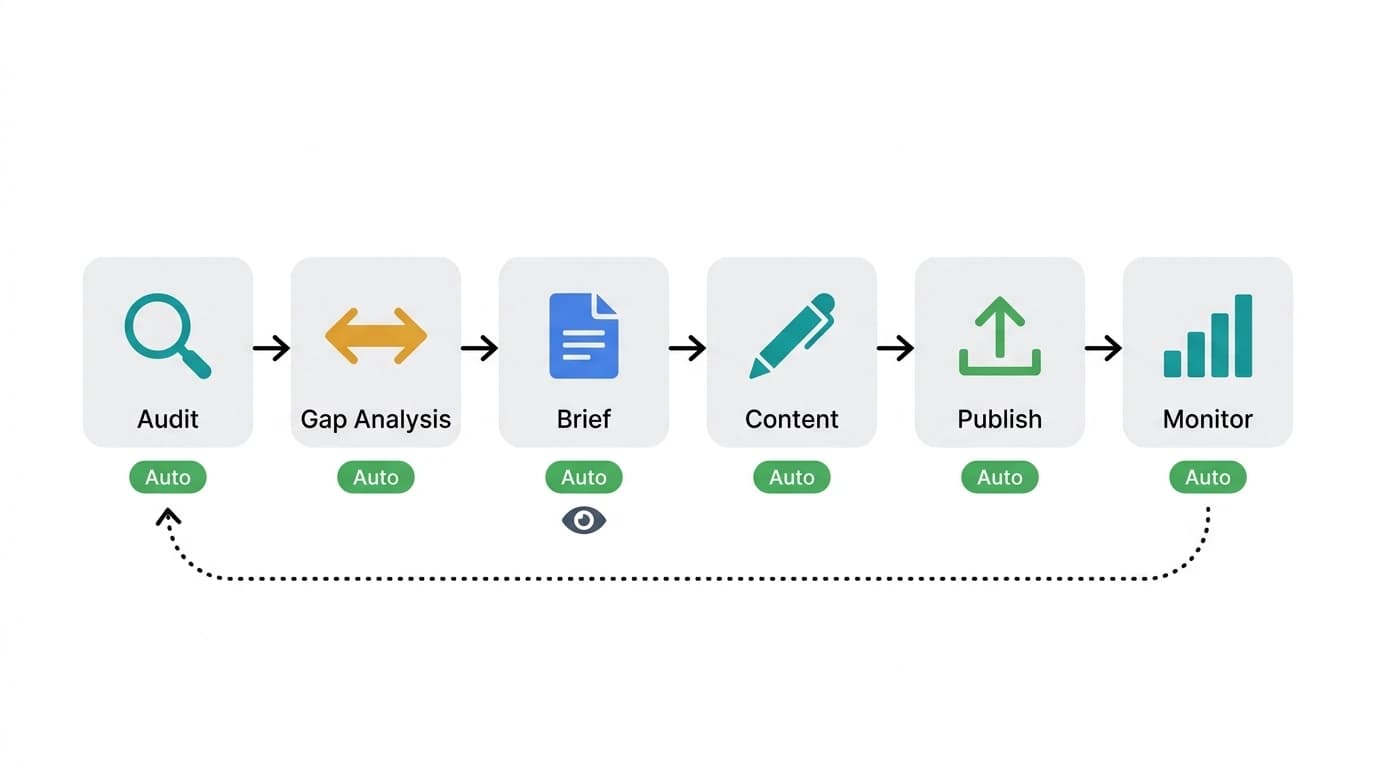
A complete SEO workflow has six steps. Understanding which ones to automate first, and in what order, determines whether you build a compounding system or an expensive treadmill.
Step 1: Audit What is your current visibility? Which pages have impressions but no clicks? Which technical issues are blocking indexation? Where are your near-win keywords sitting at position 15 to 30?
Automate this. GSC data is pull-able, processable, and pattern-recognisable by any system connected to your site. There is no reason a human should spend hours building a spreadsheet of near-win keywords every month. This is the highest-value first automation — it feeds every subsequent step.
Step 2: Competitor gap analysis Which keywords are your competitors ranking for that you are not? Which of those keywords have buyer intent? Which are winnable given your current domain authority?
Automate this. Cross-referencing your keyword positions against competitor keyword profiles is pattern matching at scale. A system can do this faster, more completely, and more consistently than a human running manual exports. The competitor gap analysis system covers the three-layer gap mapping — keyword gaps, content depth gaps, and AI citation gaps — that a complete automated system should surface simultaneously.
Step 3: Content brief generation Which topic should this post cover? What angle? What keyword? What competing pages does it need to outperform? What structure earns featured snippets?
Automate this. When the gap data from Step 2 is connected directly to brief generation, the brief emerges from the gap itself rather than a separate human research process. The target keyword is validated. The competing pages set the benchmark. The intent — informational, commercial, definition — is inferred from the SERP pattern. A brief that takes 90 minutes to write manually generates in seconds when the gap data is the input.
Step 4: Content creation The actual writing. Answer-first structure. Question-based H2 headings. FAQ sections. Data points. Schema-ready formatting.
Automate this — with brand voice input. This is where most automation guides get overcautious. AI writing works at quality when it has the right inputs: a specific keyword, a validated intent, a clear structure requirement, and brand voice context. Today's best tools handle the full pipeline: keyword research, brief generation, AI-assisted writing, on-page optimisation, indexing, and distribution. Generic AI writing without those inputs produces generic content. Automated writing with them produces content that competes.
Step 5: Publishing Formatting for Ghost or WordPress. Adding meta title and description. Schema markup. Internal links. Featured image alt text. Canonical tags. Submitting to GSC for indexing.
Automate this entirely. Publishing is pure execution. Every step in it is deterministic — there are correct answers for every field, and those answers are derivable from the content and the target keyword. A human doing this step manually is doing a job that should never have been assigned to a human.
Step 6: Monitoring Which posts are moving? Which are stalling? Which new queries surfaced this week? Which competitor published a post that opened a new gap?
Automate the detection. Keep the decisions. The monitoring layer should run continuously and surface signals automatically. The decision of how to respond — whether to update the post, build internal links to it, or write a supporting cluster piece — is a strategic call that benefits from human judgment. But the signal itself should arrive without you having to go looking for it.
What to automate first: GSC-connected gap analysis
If you are starting from zero on SEO automation, this is the one workflow to build before anything else.
Connect your Google Search Console to a system that can process the data. Tell it to find three things automatically, every week:
Near-win keywords. Queries where your site has impressions at positions 8 to 30. Google has already decided your site is relevant — you are just not ranked high enough to earn the click. These are your fastest wins. A dedicated, better-optimised page for any near-win keyword typically moves to page one in 30 to 60 days because the relevance signal is already established.
Looking at distribution.studio's own GSC data: "automate seo" sits at 213 impressions and position 51. "Ghost linkedin integration" sits at 127 impressions and position 21. "Gumroad convertkit integration" sits at 82 impressions and position 13. These are not hypothetical targets — they are real queries where the site is already surfacing, and the gap between current position and page one is closeable with the right content.
Competitor dark gaps. Queries where competitors rank and your site has zero impressions. These require new pages, not improvements to existing ones. They represent the highest-volume opportunity for content that does not yet exist on your site.
AI citation gaps. Queries where competitors are being cited in ChatGPT, Perplexity, or Google AI Overviews and you are not. This is the gap that traditional SEO tools do not surface at all — and it matters because in 2026, automating SEO workflows means monitoring not just Google rankings but also ChatGPT visibility, Perplexity citations, and AI Overview appearances. Tools that only track traditional SERPs leave a growing blind spot. For how AI citation connects to SEO automation — the loop most teams miss — that post covers the measurement framework.
What to automate second: brief generation from real data
Most content briefs are built from keyword research tools and gut instinct. Both inputs have problems at scale.
Keyword research tools give you estimated data — modelled volume, modelled difficulty, modelled competitor rankings. Your GSC gives you actual data — real impressions, real click-through rates, real query-level performance for your specific domain.
An automated brief that starts from GSC data is categorically better than one that starts from a keyword database because it is working from ground truth, not estimates. The brief knows which queries are actually driving impressions to your site. It knows which pages are performing and which are stalling. It can infer from that data what a new page targeting a specific keyword needs to include — what depth, what format, what structure — to outperform the competing pages that are already ranking.
Identify repetitive SEO tasks first: pinpoint processes like site audits, keyword tracking, or backlink monitoring that consume time. Then connect your automation tools to platforms like Google Analytics, Search Console, and your CMS for seamless data flow.
The brief generation step is where most "SEO automation" tools fall short. They generate briefs from keyword databases without GSC integration. The briefs are generic — they target the same terms every other site is targeting, without the site-specific context that makes a brief actually useful.
A brief built from your GSC data includes: the specific near-win queries to target, the competing pages that are currently ranking and what they cover, the content gaps those pages leave open, and the schema and structural requirements for the specific SERP pattern. That is a brief a writer or AI system can execute against. A keyword and a word count is not.
What to automate third: publishing with AEO structure built in
Publishing is the most underrated automation opportunity in SEO.
Most content teams spend 30 to 60 minutes per post on formatting, meta data, schema, internal linking, and CMS upload. At two posts per week, that is four to eight hours a month of pure formatting work. No judgment required. No strategy involved. Just execution.
The argument for automating publishing is not just time savings. It is consistency. When a human formats and publishes manually, schema gets missed. Internal links get forgotten. The answer-first paragraph structure that earns featured snippets gets lost in editing. The FAQPage JSON-LD that makes a post AI-citation-eligible never gets added because it was on the checklist that nobody checked.
Automated publishing means every post arrives at the CMS with the same structural completeness: question-based H2 headings, answer-first paragraph openings, FAQPage schema on every FAQ section, Article schema with datePublished and dateModified, canonical tag, meta title under 60 characters, internal links to topically related posts, and immediate GSC submission for indexing.
Every new page is an opportunity to strengthen site architecture through internal links. Automated internal linking based on semantic relevance means link equity flows to the pages that need it most without manual effort.
This consistency is why automated publishing produces better SEO outcomes than manual publishing even when the content quality is equivalent. The structural completeness that earns AI citations and featured snippets requires getting 12 things right on every post. Manual processes get 9 to 10 right consistently. Automated processes get all 12 right every time.
How to automate SEO outreach
SEO outreach — the process of getting other sites to link to your content — sits at the intersection of SEO and sales prospecting. It is the step most founders skip because it is time-consuming, rejection-heavy, and hard to systematise.
The automation case for outreach is strong, but the automation boundaries are different from content automation. The discovery and qualification steps respond well to automation. The actual outreach message needs to stay human.
Automate: prospect discovery. Finding sites that link to your competitors but not to you, identifying newly published content in your topic cluster, and monitoring for unlinked brand mentions that could become links — all of these are pattern-matching tasks that run faster and more completely as automated processes than as manual research.
Automate: message drafting. A draft first message based on the prospect's site, the specific page you are pitching, and the angle for why your content deserves a link — this can be generated automatically and reviewed by a human before sending. The review takes two minutes. Writing from scratch takes twenty.
Keep human: the send and the follow-up conversation. LinkedIn and email outreach that arrives at scale without personalisation gets ignored or flagged. The automation value is in getting to a review-ready draft in seconds. The human value is in the judgment call of whether to send, and in any reply conversation that follows.
For distribution.studio specifically, Reddit monitoring and LinkedIn intent signal monitoring produce warmer outreach targets than cold link building — because the target has already demonstrated interest in the topic. Founders asking for SEO tool recommendations in r/SaaS are more likely to link to useful content than a random blog with high domain authority that you found through a backlink analysis. The complete SEO automation guide covers the full Reddit and LinkedIn monitoring workflow alongside the content automation stack.
What stays human — and why
Automation sceptics often conflate "removing humans from execution" with "removing humans entirely." They are not the same thing.
The things that stay human in a well-built SEO automation system:
Market positioning decisions. Which audience segment matters most right now? What makes your product different from competitors in language your ICP actually uses? What topics are strategically important beyond what GSC data shows? These require judgment about your business, not pattern matching across data.
Brand voice calibration. The specific vocabulary, rhythm, and tone that makes your content recognisably yours. This can be documented and used as input for automated content, but the calibration itself requires a human who knows what the brand sounds like and can tell when the output has drifted.
Anomaly interpretation. When traffic drops sharply or a ranking falls unexpectedly, the automated system surfaces the signal. The interpretation of why it happened and what to do about it requires context that the system may not have — a competitor launched a major update, Google changed how a SERP feature works, your product changed significantly since the content was written.
The editorial judgment call. Not every brief that the system generates should be executed. Some topics are off-strategy. Some competitive gaps are not worth closing. Some pages that have stalled need consolidation rather than improvement. These calls require understanding your business priorities in ways that GSC data alone cannot inform.
The future SEO specialist will be less of a technician and more of a strategist. Automation handles the repetitive tasks. The specialist focuses on the decisions that data cannot make.
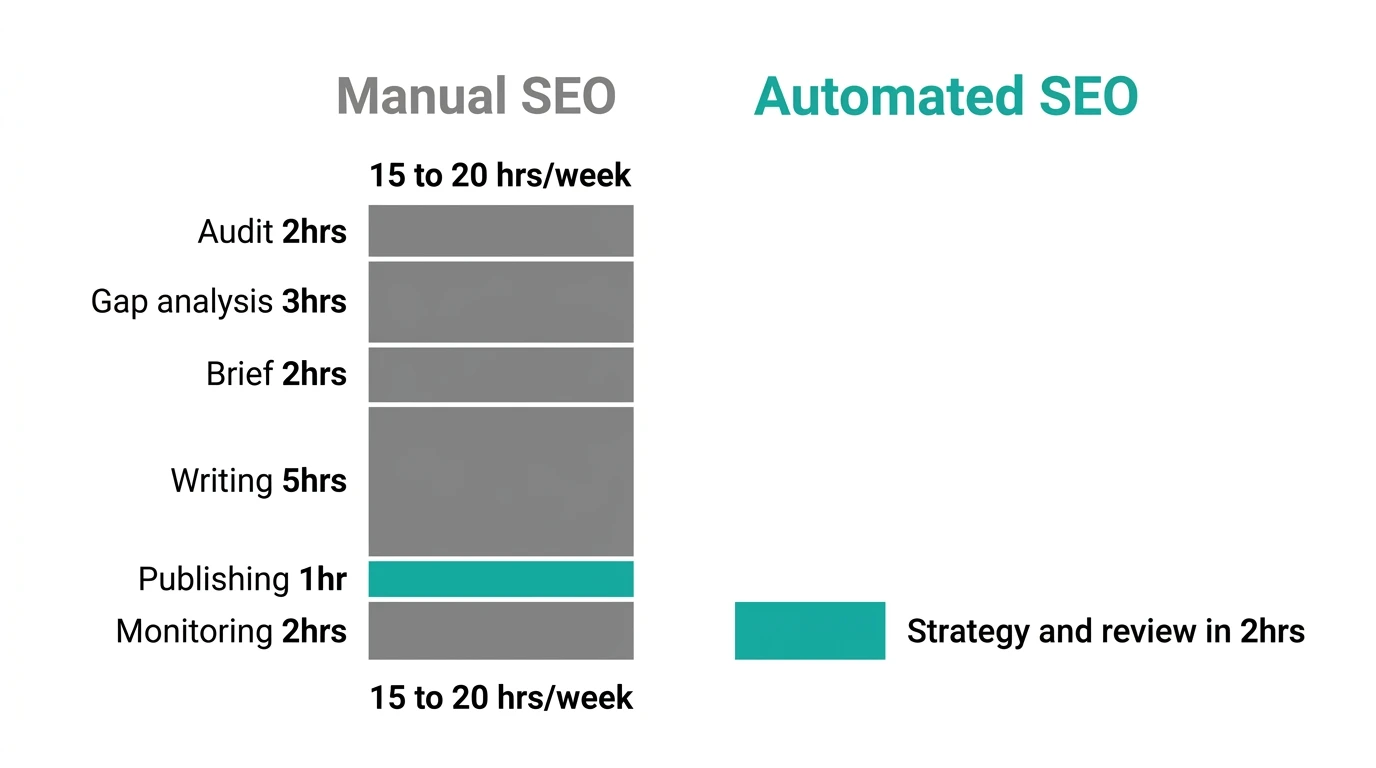
For a founder, this reframing matters practically. SEO automation does not eliminate SEO from your workload. It compresses it from 15 to 20 hours of execution per week to 2 to 3 hours of strategic decisions per week. That 12 to 17 hours recovered is the compounding advantage — it goes back to building the product.
The loop most SEO automation guides miss: AI citation
Traditional SEO automation guides end at Google rankings. In 2026, that is stopping halfway.
Your buyers are asking ChatGPT, Perplexity, and Google AI Overviews for product recommendations before they type a search query into Google. If your automated content is not structured for AI extraction — answer-first paragraphs, FAQPage schema, entity consistency, question-based headings — it will rank on Google and remain invisible to AI systems simultaneously.
This is why Google rankings do not predict AI citations. The two surfaces use different signals. Automating SEO for only one of them leaves the other ungoverned.
The complete automation loop includes monitoring your AI citation share — which queries cite you on ChatGPT, Perplexity, Gemini, and Claude — alongside your traditional GSC data. When a citation gap surfaces, the same brief generation and publishing workflow that closes keyword gaps also closes citation gaps. The inputs are different. The execution is the same.
This is the loop Thoth runs. GSC data and AI citation monitoring feed the same gap identification system. Gaps generate briefs. Briefs generate content. Content publishes with AEO and GEO structure built in. Citations and rankings feed back into the next monitoring cycle. The loop compounds. Each piece of content that earns a citation makes the next piece easier to cite, because the domain's entity authority grows with each new reference.
How Thoth compares to SpreadJam — both tools position themselves in the AI SEO automation space — covers the specific execution differences for teams evaluating the category.
The 30-day SEO automation setup
If you are starting from zero and want a concrete sequence:
Week 1: Connect your data. GSC connected. Competitor domains identified (your three to five real SEO competitors, not your business competitors). Near-win keyword list extracted — queries where you have impressions at positions 8 to 30. Dark gap keyword list extracted — queries competitors rank for with zero impressions on your site.
Week 2: Automate the brief. Take the top five near-win keywords and the top five dark gap keywords. Build a brief template that takes keyword, competing pages, and SERP intent as inputs and outputs a structured content outline with H1, H2s, FAQ questions, and schema requirements. Run it for all ten targets. Review and select the top three to execute first.
Week 3: Automate the publish. Set up your CMS connection so drafted content arrives formatted, meta-tagged, schema-marked, and internally linked without manual intervention. Test with one post. Verify every structural element is present. Then run the remaining two briefs from Week 2 through the same pipeline.
Week 4: Set up monitoring. GSC monitoring for new near-win queries that surface from newly indexed content. AI citation monitoring for the queries your new posts are targeting — check whether they appear in ChatGPT, Perplexity, and Google AI Overviews. Competitor monitoring for new posts in your topic cluster that might open new gaps.
At the end of 30 days, you have a system running rather than a backlog waiting. Three posts published. Ten briefs ready. Monitoring surfacing signals weekly. The compounding has started.
FAQ
Thoth closes the full SEO automation loop — GSC-connected gap analysis, content generation with AEO and GEO structure built in, Ghost CMS publishing, and AI citation monitoring — without a human in the execution handoffs. Free audit at [distribution.studio](https://distribution.studio). Paste your URL. See your near-win keywords, dark gaps, and AI citation gaps in 10 minutes.
Back to all blogs