Automated LinkedIn prospecting for B2B SaaS: the 2026 workflow
Your ideal customer just updated their LinkedIn headline to "Head of Growth at [new startup]."
They started the role eight days ago. Their old marketing stack does not work for their new company's stage. They are actively evaluating tools. They have not Googled anything yet because they are still figuring out what the problem is.
That window — between the trigger event and the first search query — is where the best B2B SaaS deals are won. Most sales teams miss it entirely because they are waiting for the prospect to come to them.
LinkedIn is where those trigger events are public, searchable, and actionable in real time. LinkedIn delivers 277% higher lead generation effectiveness than Facebook and Twitter combined. Not because LinkedIn has better ad targeting or a bigger audience. Because it is the only platform where your buyers announce their buying triggers publicly — job changes, growth announcements, tool complaints, recommendation requests — before they have decided what to buy.
This post covers exactly how to find those signals, what to do when you find them, and how to monitor at scale without spending three hours a day scrolling a feed.
Why LinkedIn is your highest-concentration buyer channel
Every social platform has buyers on it. LinkedIn is the only one where buyers self-identify their role, company size, industry, and buying context in their public profile.
A founder posting on X might be venting. A founder posting on LinkedIn is building a professional record. The audience they are speaking to is their professional network — peers, potential partners, potential vendors. The intent behind LinkedIn activity is categorically different from any other platform.
Three numbers define the opportunity:
Roughly 40% of B2B buyers say they have reached out to a vendor after seeing them on LinkedIn. Not after seeing an ad. After seeing organic content or a profile that demonstrated relevant expertise.
Companies using intent-driven outreach report up to 93% higher conversion rates than traditional methods. Intent-driven means contacting a prospect because they showed a buying signal — not because they matched a firmographic filter on a list.
A good LinkedIn connection rate in 2026 ranges from 30% to 45%, with 10 to 25% response rates for well-targeted outreach. Those numbers are significantly higher than cold email because the context is social, not transactional.
The gap most SaaS teams leave open: they treat LinkedIn as a broadcasting platform. Post content, hope people notice, send generic connection requests to everyone who fits the ICP filter. That approach produces followers, not pipeline.
AI search compounds this gap. The 2026 AI CMO benchmark data shows that Perplexity cites sources at 13.05% frequency and ChatGPT converts AI-referred visitors at 11x the rate of organic search. The buyers you reach on LinkedIn before they search are the same buyers who will find your competitors via AI citation if you are not cited there too.
The approach that produces pipeline is monitoring for signals before you reach out — so every message you send is contextually relevant to something the prospect just did or said publicly.
The three LinkedIn signals that indicate active buying intent
Not every LinkedIn activity is a buying signal. Most is not. The skill is knowing which specific actions indicate that a prospect is in the market right now rather than six months from now.
Here are the three signals worth acting on immediately:
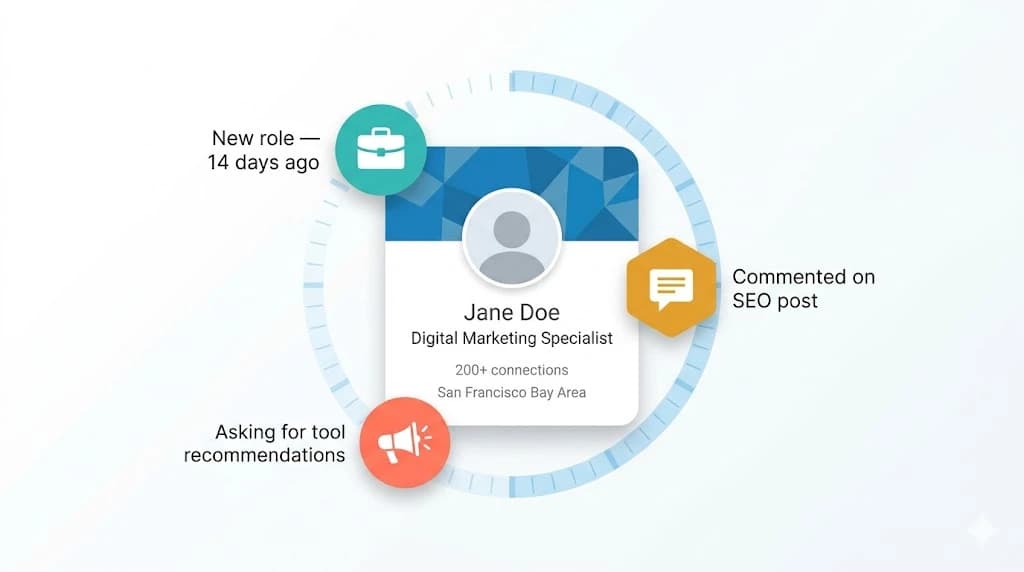
Signal 1: The job change. This is the single most reliable buying intent signal on LinkedIn. A founder or growth lead starting a new role in the first 90 days is in full evaluation mode. Their old tools do not come with them. Their new company has different problems at a different stage. They are building their stack from scratch and open to recommendations in a way they will not be six months in when everything is settled.
The window is not infinite. Reach out within the first 30 days of a job change and you are in the evaluation conversation. Reach out at day 91 and you are trying to displace something they have already decided to keep.
Signal 2: The content engagement signal. When a prospect likes, comments on, or shares content about a problem your product solves — that is a buying intent signal. Not a weak one. A strong one. They took a public action that says "this problem is on my mind right now."
A comment on a post about SEO automation challenges from a founder at a 15-person SaaS company is more valuable than 100 email addresses from a purchased list. The right response is not a pitch. It is a genuinely useful reply that demonstrates you understand the problem — followed by a connection request with a contextual note referencing what they said.
Signal 3: The explicit recommendation request. The most direct signal of all. A post that says "looking for recommendations on SEO tools for an early-stage SaaS team" or "what is everyone using for content automation?" is a buyer publicly announcing they are in the market.
The challenge: these posts disappear from feeds quickly. A recommendation request posted on Tuesday morning has most of its engagement by Tuesday afternoon. If you see it on Thursday, the prospect has already had 15 conversations without you. The timing problem is the execution problem.
For how competitor intelligence extends to social signals, that post covers tracking competitor LinkedIn activity as an additional intelligence layer.
How to find these signals without Sales Navigator
Sales Navigator works. It also costs $79 to $99 per month per seat. Here is the manual approach that works before you have the budget or volume to justify it.
For job change signals: Go to your first-degree connections list and filter by "Recently changed jobs." LinkedIn shows this in the notifications tab under "Career milestones." For second-degree connections, search your target job titles and filter by "Changed jobs in the last 90 days" using the People filter. This surfaces active evaluators without any third-party tool.
For content engagement signals: Follow the founders and growth leads at companies in your ICP. Check their recent Activity tab — any activity touching your problem space is a warm signal. Ten minutes of manual profile checking per prospect tells you whether they are actively thinking about the problem you solve.
For recommendation requests: Search LinkedIn for the exact phrases your buyers use: "looking for recommendations," "what tools do you use for," "alternatives to," combined with your category terms. Filter results to Posts, last 24 hours. Run this search twice a day — morning and early afternoon — to stay within the engagement window.
Boolean search operators improve results significantly. For example: ("Founder" OR "Co-Founder") AND ("SEO tool" OR "marketing automation") NOT "looking to hire"
For the full tactical breakdown, see the full LinkedIn prospecting guide.
The outreach framework that earns replies
A connection request that reads like a template gets ignored or declined. A connection request that references something specific the prospect just did gets accepted at 30 to 45%.
The framework has three components:
The trigger reference. Open with a specific reference to the signal you observed. Not "I noticed you work in SaaS." "Saw your comment on [topic] post — the problem you described with content scaling is exactly what we built Thoth to solve." That sentence shows you were paying attention to something they said, not running a list.
The one-line value prop. One sentence connecting your product directly to the problem they just demonstrated publicly. "We built an AI CMO that handles the full SEO and content cycle automatically — brief, write, publish, monitor — so founders do not need a content team to scale organic."
The low-friction ask. Not "book a 30-minute demo." Something that requires almost no commitment: "Happy to share what we have built if it sounds relevant." Or simply connecting without any ask — building the relationship before the pitch.
AI-personalised messages increase response rates by up to 61% when they use tailored templates for job changes, content references, and mutual connections. The personalisation does not need to be deep. One detail that could not have been copy-pasted from a template is enough to move from the ignored pile to the considered pile.
Three message templates for each signal type
Job change message (under 300 chars):
Hey [Name] - congrats on the new role at [Company].
First 90 days are usually when the tool stack gets
rebuilt. If SEO and content automation are on the
list, Thoth might be worth a look. Happy to share
more if useful.
Content engagement message:
Hey [Name] - your comment on [topic] resonated.
The manual SEO loop you described is exactly the
problem we built Thoth to remove. AI CMO that
audits, writes, and publishes automatically.
Free audit at distribution.studio if you want
to see your gaps.
Recommendation request message (reply in comments first, then DM):
Hey [Name] - replied to your post about [tool
category]. Thoth might fit what you are looking
for - AI CMO that handles SEO, competitor gaps,
and content publishing in one system. Free audit
at distribution.studio if you want to test it.
Why the profile matters as much as the message
Every prospect who receives your message looks at your profile before they decide whether to accept or reply. A profile that looks like a salesperson's pitch page gets ignored. A profile that looks like a founder solving a real problem gets engaged.
Your headline should describe the problem you solve, not the role you hold. "Building Thoth — AI CMO for SaaS founders doing marketing without a team" is more compelling than "Co-Founder at Distribution Studio." The former tells the prospect immediately whether you are relevant to them.
Your featured section should link directly to the free audit at distribution.studio — not your homepage. The audit is your lowest-friction conversion point and it should be the first thing a visiting prospect sees.
Why manual LinkedIn monitoring does not scale
Monitoring job changes, content engagement signals, and recommendation requests manually means checking LinkedIn multiple times a day, running Boolean searches for each signal type, reading individual profiles for context, and crafting personalised messages — all before the engagement window closes.
Monitoring three signal types across your target ICP manually takes 60 to 90 minutes per day. At the volume needed to build consistent pipeline, that is a part-time job before you have sent a single message.
The second problem is consistency. Manual monitoring works on Tuesday when you remember. It fails on the day you have three product fires, a team meeting, and a timezone that misaligns with your buyers' posting schedules.
The automated Airtable workflow
To solve the scale problem, transition from manual checking to an automated inbound lead feed. Here is the exact architecture to pull LinkedIn intent data into Airtable for processing:
Step 1: The trigger. Use a tool like PhantomBuster or Apify to run a daily scrape of your ICP list specifically filtering for "Changed jobs in last 90 days." Send this raw data via webhook to a Make.com scenario.
Step 2: The Airtable ingestion. In Make.com, map the JSON payload to an Airtable base. Your base should have columns for: Prospect Name, New Company, LinkedIn URL, and a status column defaulting to "New Lead."
Step 3: AI enrichment. Create an Airtable automation triggered when a new record enters the "New Lead" view. Pass the prospect's data to the OpenAI integration block to automatically draft the custom job change icebreaker message outlined above, storing it in a "Draft Message" column.
Step 4: Human review and deployment. Log into Airtable, review a pre-qualified list of buyers in the exact engagement window, check the AI-drafted message for tone, and push a button to send them directly to your outbound sequence via webhook to a tool like SwitchStack.
This setup takes about 30 minutes to build. Once running, your LinkedIn prospecting pipeline runs continuously without daily manual checking.
Thoth's automated LinkedIn monitoring runs this logic continuously — scanning for job change events, content engagement signals, and recommendation requests from your target ICP in real time. High-intent signals surface in your dashboard with the context needed to respond within the window.
And once the signal surfaces and the conversation starts, SwitchStack closes the loop — power dialer, AI call coaching, and personalised outbound sequences running from the same intent data. Thoth finds the signal. SwitchStack converts it into pipeline.
LinkedIn and Reddit: the community-led growth stack
LinkedIn and Reddit are not competing channels. They surface different buyer types at different moments in the buying journey.
Reddit buyers are in the moment — posting a problem or recommendation request right now, in a community of peers. The signal is raw and the intent is immediate. Engagement window is 1 to 3 hours.
LinkedIn buyers are in context — a job change, a post, a comment that reveals professional priorities. The signal is more considered and the window is longer: 30 days for a job change, 24 to 48 hours for a content signal.
Running both channels simultaneously covers buyers at two different intent levels. The Reddit post finds the founder who is shopping right now. The LinkedIn job change finds the founder who will be shopping in two weeks. Reddit monitoring as the companion channel covers the real-time layer. LinkedIn prospecting covers the relationship layer.
Together they form a community-led growth system that produces pipeline no inbound SEO strategy reaches on its own — the buyers who have not yet Googled your category, who will not see your blog post for weeks, but who are actively in the market right now because their professional context just changed.
FAQ
Thoth monitors LinkedIn for buying intent signals in your ICP continuously — job changes, recommendation requests, and content engagement from founders actively evaluating tools — and surfaces them in real time so you never miss the window. Free audit at [distribution.studio](https://distribution.studio).
Back to all blogs