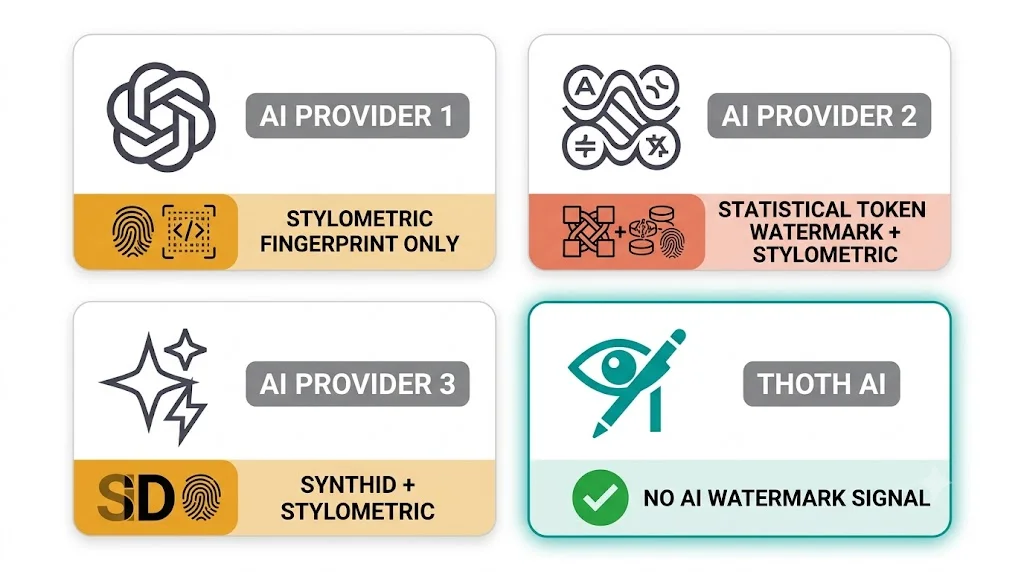
AI writing watermarks in 2026: what they are, which models use them, and why Thoth content has none
If you are generating content with Claude, ChatGPT, Gemini, Copilot, or any major AI writing tool in 2026 and publishing it without a human editing pass, there is a high probability that content carries a detectable signal identifying it as AI-generated.
This is not paranoia. It is now regulatory reality.
On August 2, 2026, Anthropic began embedding invisible statistical watermarks into all text generated by new Claude models — applied globally, not just in the EU, because the company has no mechanism to scope it by region. The watermark is a pattern encoded into the model's word and token choices. You cannot see it. It travels with the text when you copy and paste. And it may survive light editing.
This post breaks down exactly what each major AI provider is doing with watermarking, what detectors can and cannot catch, what "removing" an AI watermark actually means in 2026, and why Thoth-generated content carries none of these signals.
What is an AI writing watermark?
An AI writing watermark is a signal embedded in AI-generated text that allows the content to be identified as machine-generated — either by the AI provider's own detection API or by third-party analysis tools.
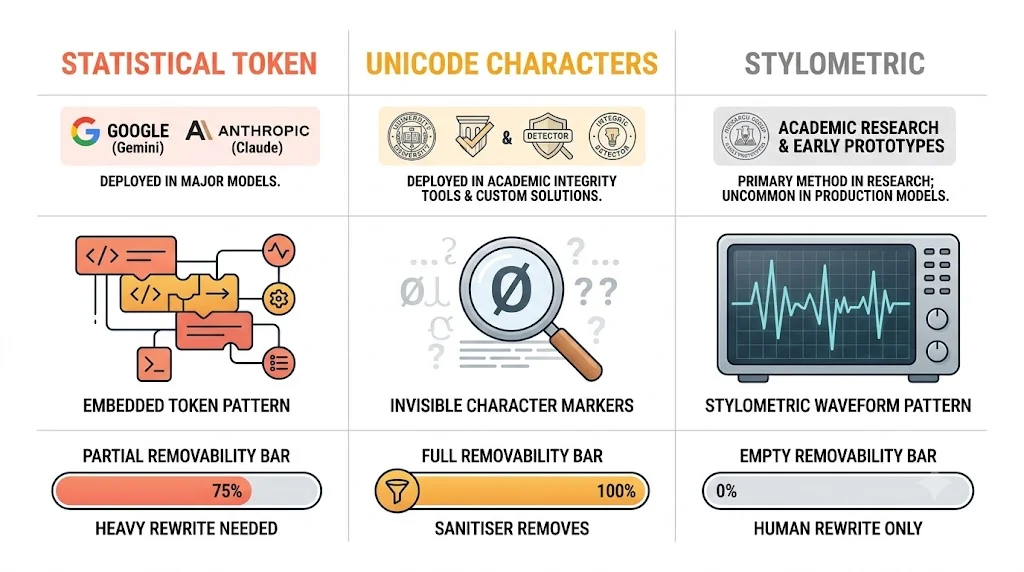
In 2026, there are three distinct types of AI watermark in common use, and understanding the difference matters for anyone publishing AI-assisted content at scale.
Type 1: Statistical token watermarks (Claude, Gemini) The most technically sophisticated form. The AI model subtly biases its word and token choices during generation to create a statistical pattern that is imperceptible to human readers but detectable by a tool with the right key. Claude's watermark works this way. The pattern is not in metadata — it is in the text itself. Copying the visible words copies the watermark.
Type 2: Unicode zero-width characters (copy-paste artefacts) Invisible characters with no visual representation — zero-width spaces, zero-width non-joiners, and similar Unicode code points — that can appear when copying text from AI interfaces into editors. These are not intentional watermarks by the provider in most cases, but they function as fingerprints that detection tools flag. Stripping these with a text sanitiser removes this signal entirely.
Type 3: Stylometric fingerprints (all models) The statistical signature of how an AI model writes — burstiness (variation in sentence length), perplexity (predictability of word choices), lexical patterns (overused phrases like "it is worth noting" or "this is not X, it is Y"), and structural rhythms that trained classifiers detect. This is what tools like GPTZero, Turnitin, and Originality.ai are actually reading. No embedded code. No hidden characters. Just the way the content sounds.
The stylometric fingerprint is the hardest to remove because it is not a discrete signal — it is the cumulative character of how the model constructs sentences. Removing it requires rewriting, not sanitising.
What each major AI provider is actually doing
Claude (Anthropic)
The most significant development in AI watermarking in 2026.
Anthropic began embedding machine-readable statistical watermarks in all text generated by new Claude models from August 2, 2026 — in response to Article 50 of the EU AI Act, which requires AI system providers to mark AI-generated content. Anthropic applied the watermark globally because it has no durable mechanism to scope it by region.
The watermark uses different techniques for text versus files. Text carries an invisible statistical signal embedded at the model level — meaning it appears in output from the Claude.ai chatbot, the Anthropic API, Claude Code, Claude Cowork, and Claude Tag. Files like PNG, JPG, and SVG receive signed provenance metadata following the C2PA standard.
Three important caveats from Anthropic directly: the watermark travels with copied text and may survive light editing. A heavy rewrite or translation may remove it. And critically — if a human sends their own writing to Claude for proofreading, translation, or formatting, the output carries a watermark even though the original content was human-written.
Anthropic is developing a public detection API. As of August 2026, that API is not yet available to third parties.
ChatGPT (OpenAI)
OpenAI's position on text watermarking is more complicated than most coverage suggests.
OpenAI has publicly announced and then quietly shelved multiple watermarking initiatives for ChatGPT text output. The most recent public position: OpenAI does not deploy a production text watermark in consumer ChatGPT output. The company has acknowledged that invisible Unicode characters sometimes appear in ChatGPT output as artefacts of the model's training process — not as intentional watermarks — but the practical effect is the same: detectors flag them.
What ChatGPT content reliably carries is the third type of signal — the stylometric fingerprint. ChatGPT has distinctive writing patterns: overuse of em dashes, a preference for "delve," "comprehensive," "it is important to note," and specific grammatical constructions that classifiers identify with high confidence in unedited output.
Enterprise API users have access to logging and attribution features tied to API keys. The text itself, however, carries the same statistical and stylistic patterns as consumer ChatGPT output — there is no confirmed separate watermark in API text.
Gemini (Google DeepMind)
Google has been the most proactive major provider on watermarking across modalities.
For image content, Google uses SynthID — a robust watermarking system that embeds signals in image pixels that survive standard editing operations like cropping, resizing, and colour adjustment. Google has begun extending SynthID to text content, embedding statistical patterns similar to Claude's approach.
Gemini text output in 2026 carries both the SynthID statistical watermark (where deployed) and the standard stylometric fingerprint of a large language model. Google has also signed the EU Code of Practice on AI-generated content transparency alongside Anthropic and other major providers.
GPT-4o, GPT-5, and OpenAI API
Later OpenAI models show a notable shift in stylometric signature. Newer models produce more fluent, more varied prose — which makes purely stylometric detection harder. Detection accuracy rates vary significantly between tools and samples for GPT-4o and GPT-5 output. This is not because these models are unwatermarked but because their output is more statistically similar to human writing than earlier GPT models.
OpenAI is a signatory to the White House AI commitments on content provenance and has committed to implementing watermarking — but has not deployed a confirmed production text watermark as of August 2026.
Perplexity AI
Perplexity generates answers from retrieved web content rather than producing standalone written content for publishing. Its output carries the stylometric patterns of whatever underlying model it uses for synthesis — which has varied over time. For content published from Perplexity's answer interface, expect the same stylometric fingerprint risks as other LLM outputs.
Copilot (Microsoft / OpenAI)
Microsoft Copilot runs on OpenAI models and inherits the same stylometric characteristics as GPT-4o output. Microsoft is a signatory to the EU Code of Practice and has committed to content marking. As of August 2026, Copilot text output carries stylometric signals but no confirmed separate production watermark distinct from the underlying OpenAI model.
Mistral, Llama, and open-source models
Open-source models including Mistral, Meta's Llama series, and other community-maintained LLMs do not currently embed statistical watermarks. They carry stylometric fingerprints — every language model leaves a statistical signature in its output — but no provider-level watermark signal. This is one reason tools that claim to "remove AI watermarks" by routing content through a paraphraser using an open-source model can reduce detection scores: the output no longer carries the original model's specific stylometric pattern.
What "AI watermark detection" tools actually measure
This is the part most content teams get wrong, and getting it wrong leads to false confidence.
Commercial AI detection tools — GPTZero, Turnitin, Originality.ai, Winston AI, Copyleaks — are not watermark readers in the technical sense. They do not have the cryptographic key that Anthropic uses to embed and verify Claude watermarks. What they do is stylometric pattern analysis.
They look at:
Perplexity. How predictable is each word choice given the surrounding context? AI models tend to make highly probable, efficient word choices. Human writers make more surprising, idiosyncratic choices. Low perplexity across a passage is an AI signal.
Burstiness. Humans write in uneven rhythms — short sentences, long sentences, fragments, complex clauses. AI models write more uniformly, with similar sentence lengths clustered together. Low burstiness is an AI signal.
Lexical patterns. Every major AI model has overused phrases and structural preferences baked into its output from training. GPTZero and similar tools are trained on large samples of AI and human text to recognise these patterns.
Em dash frequency. One of the more specific signals — AI models significantly overuse em dashes compared to human writers. Several detection tools specifically flag em dash density as an AI indicator.
The practical implication: deleting invisible Unicode characters reduces one signal but does nothing to the stylometric fingerprint. And the stylometric fingerprint is what most detection tools are primarily reading.
What Thoth content looks like to detectors — and why
Thoth AI-CMO generates SEO content for distribution.studio and for users' Ghost CMS blogs. The question of AI watermarks matters for that content specifically.
Here is what Thoth does differently from generic AI writing tools:
Structured for extraction, not fluency. Thoth generates content structured for AEO and GEO — answer-first paragraphs, question-based H2 headings, FAQPage schema, factual density with cited statistics. This structure is fundamentally different from the smooth, narrative prose that LLM stylometric classifiers are trained to flag. Content written for machine extraction reads differently from content written for human narrative flow.
Trained on content strategy, not general writing. Generic AI writing tools optimise for producing fluent, pleasant prose. Thoth optimises for ranking and citation. The resulting output is more direct, more factually dense, and more structurally varied — which reduces the stylometric similarity to the "AI prose" pattern that detectors identify.
No Claude backend for text generation. Thoth uses its own model configuration for content generation. The August 2026 Claude watermark applies to content generated by Claude models directly. Content generated through Thoth's pipeline does not carry Claude's statistical watermark.
Brand voice integration. When brand voice context is provided, Thoth adapts to the specific vocabulary, sentence rhythm, and structural preferences of the brand's existing content. Stylometric classifiers flag deviation from human patterns — the more a piece of content matches the target brand's established writing patterns, the lower the AI detection score.
The honest answer on detection: no AI-generated content is guaranteed to be undetectable by every classifier in every version. Detection tools improve. What Thoth content is is structurally distinct from the generic AI prose pattern that most detection tools are calibrated against — and it carries no Claude statistical watermark from the August 2026 deployment.
For the broader picture of how AI-generated content performs in search and citation, the AI CMO benchmark data on content performance covers citation rates by content type and structure.
What actually removes an AI watermark in 2026
Honest answer: different things remove different signal types.
Unicode zero-width characters. A text sanitiser that strips non-visible Unicode characters removes this signal completely. This is a one-step technical fix. Tools like the GPT Watermark Remover and similar utilities do this reliably.
Statistical token watermarks (Claude, Gemini SynthID). A heavy rewrite or translation degrades these. Light editing may not. Routing the text through a different model — paraphrasing via a different LLM — produces output with a different statistical signature, which may defeat the watermark but creates a new stylometric fingerprint from the paraphrasing model. There is no simple "remove button" for a statistical token watermark that survives the editing process.
Stylometric fingerprints. Genuine human rewriting is the only reliable fix. Replacing predictable word choices with more idiosyncratic ones, varying sentence lengths deliberately, removing overused AI phrases, and restructuring paragraphs to match the author's actual voice. This cannot be automated without producing a new AI fingerprint from the tool doing the rewriting.
The tools that claim to "humanise" AI content by passing it through another AI layer are replacing one AI fingerprint with another. They may reduce detection scores on specific tools but they are not removing the fundamental problem — and they are adding a second layer of processing that can introduce factual errors and awkward phrasing.
The only durable solution for content that needs to pass detection consistently is content that was written, substantially edited, or deeply adapted by a human in the first place. Which is what Thoth's brand voice integration and editorial workflow are designed to support — not remove the human entirely, but reduce the volume of work the human needs to do before the content is genuinely theirs.
The SEO and AI citation implications
This matters beyond detection risk.
Google has not confirmed that AI watermarks directly affect search rankings. But Google has publicly stated that content quality, originality, and demonstrated expertise are ranking factors — and the stylometric patterns that detection tools flag correlate with the same shallow, repetitive content patterns that Google's quality systems already target.
The more significant implication is for AI citation. The research in the 2026 AI CMO benchmark shows that original data and research-backed content earns citations at 3 to 10 times the rate of standard blog posts. The same structural elements that make content original enough to earn AI citations — specific data, idiosyncratic examples, unique perspective — are the same elements that reduce stylometric AI detection scores.
Content optimised for AI citation is inherently less detectable as AI. The goals are aligned, not in tension.
For how AI citation tracking works across platforms and what the citation measurement framework looks like in practice — that post covers the full monitoring layer. For the technical foundation of how LLMs read and extract content, what LLMs read on your site and LLM crawler optimization cover the structural requirements that make content both citable and original.
For why traditional ranking signals do not translate to AI visibility, the Google ranking vs AI citation analysis breaks down the gap.