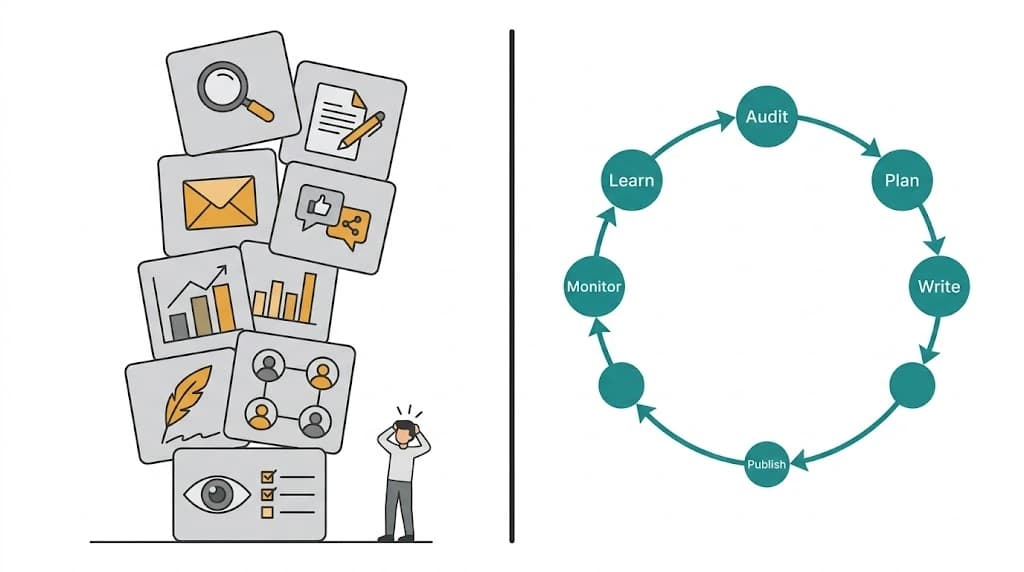
The SaaS marketing stack in 2026: what to keep, what to cut, what AI replaces
The average SaaS company runs 91 marketing tools in 2026. The typical team actively uses fewer than half of them.
That is not a tooling problem. It is a sequencing problem.
Founders buy software the way they buy ads: reactively, in response to a quarter that did not hit. Semrush because rankings dropped. Jasper because the content team was slow. A cold email platform because outbound felt broken. A Reddit monitoring tool because someone mentioned it on a podcast. Then the stack ossifies, attribution breaks, and six months later you are paying $1,400 a month for tools that each do one thing and hand the work back to you.
In 2026 the marketing stack question is not "which tools should I add?" It is "which layers does AI now execute better than a tool ever could?"
This post is the honest audit: what is still worth paying for, what you should have cut already, and which functions AI has replaced so completely that keeping the legacy tool is just expensive habit.
Whether you are running a SaaS in the US, UK, UAE, or across Europe, this applies — the tools and tactics here work regardless of market.
The state of the SaaS marketing stack right now
Three numbers define the problem:
The average SaaS company now uses 91 marketing tools, up from 65 tools in 2024. More tools did not produce better results. They produced more dashboards, more context-switching, and more budget allocated to software that nobody owns.
Businesses now spend an average of $7,900 per employee annually on SaaS tools, a 27% increase over two years. For a five-person early-stage team, that is nearly $40,000 a year in SaaS spend before a single dollar goes to acquisition.
Most SaaS founders waste 60 to 70% of their marketing budget on tactics that do not match their stage. They copy enterprise playbooks when they are bootstrapped.
The stack problem compounds the tactics problem. You are paying enterprise tool prices on a bootstrap budget, managing six disconnected platforms, and spending 15 to 20 hours a week being the integration layer between all of them.
Three structural shifts in 2026 are making this worse and creating the opportunity to fix it:
AI Overviews are eating informational traffic. Organic CTR drops 34.5% on queries that trigger AI Overviews. Tools built purely around Google ranking are losing their value proposition as AI search captures the query before the click happens.
AI has moved from a productivity tool to an autonomous execution layer. Leading teams now use AI agents to manage lifecycle email campaigns, score leads in real time based on behavioural signals, and run predictive churn models. The tools that only surface data without executing on it are being replaced, not upgraded.
Gartner found that 33% of marketing leaders now say reducing MarTech complexity is their top priority, up from 19% in 2022. The consolidation wave is here. The question is whether you get ahead of it or react to it.
The typical early-stage SaaS marketing stack (and what it actually costs)
Before cutting anything, map what most early-stage SaaS teams are paying for. This is the stack most founders have assembled by the time they hit $200K ARR:
| Layer | Typical tool | Monthly cost |
|---|---|---|
| SEO and keyword research | Semrush or Ahrefs | $140 to $250 |
| Content optimisation | Surfer SEO or Clearscope | $79 to $170 |
| AI writing | Jasper or Copy.ai | $49 to $69 |
| Cold email | Instantly or Apollo | $97 to $149 |
| CRM | HubSpot Starter or Pipedrive | $45 to $90 |
| Analytics | Google Analytics + Hotjar | $0 to $89 |
| Social monitoring | Manual or Mention | $0 to $99 |
| Email marketing | Mailchimp or MailerLite | $0 to $50 |
Total: roughly $410 to $966 per month, before any paid acquisition. Plus 15 to 20 hours of weekly time spent being the system that connects all of them.
Early-stage startups with fewer than 10 people should budget between $500 and $2,000 per month for SaaS tools. Most are at the top of that range before they have a single tool that actually executes rather than informs.
Layer 1: SEO and keyword research - cut the dashboard, keep the data
The old model: Pay $140 to $250 a month for Semrush or Ahrefs, export CSVs, highlight the gaps, build a content calendar, brief a writer, and repeat.
What changed: Semrush and Ahrefs have world-class data. They are also the clearest example of a tool that gives you homework rather than results. The data is there. The gap is there. But execution still falls entirely on you: brief, write, publish, monitor. That execution gap is exactly what AI has closed.
What to keep: Your Google Search Console integration. GSC is free, gives you real performance data about your actual site, and is the most valuable input for any SEO system. Never replace it. Augment it.
What to cut: Standalone Semrush or Ahrefs subscriptions if you do not have a dedicated SEO analyst using them daily. These tools are built for teams, not founders. At $140 to $250 a month, you are paying for depth you are not using.
What AI replaces: The gap identification, content brief generation, writing, and publishing cycle. An AI CMO system connects to your GSC data, surfaces near-win keywords and competitor gaps automatically, writes the content, and publishes it. The analysis you were doing manually in Semrush becomes an output of the system rather than an input to a manual workflow. Start by identifying keyword gaps in your SEO layer, then see how competitor gap analysis fits into your stack when it is automated rather than a periodic manual exercise.
Layer 2: Content creation - AI writing tools are being replaced by AI execution
The old model: Pay for Jasper or Copy.ai to write faster. Still brief the content yourself. Still edit. Still publish manually. Still monitor whether it ranks.
What changed: AI has moved from a productivity tool to an autonomous execution layer. Jasper makes you faster. An AI execution system removes you from the loop entirely. The difference is not speed. It is whether you are still in the workflow at all.
What to keep: Nothing in this category if you have an AI CMO system. A standalone AI writing tool is the bridge you use when you do not yet have the system. Once the system is running, the bridge is redundant.
What to cut: Jasper, Copy.ai, or any standalone AI writing subscription. They solve the writing bottleneck without solving the briefing, publishing, or monitoring bottleneck. You are paying to go from step 2 to step 3 faster while still doing steps 1, 4, 5, and 6 manually.
What AI replaces: The entire content production cycle from gap to published page. Not just the writing, the brief, the keyword structure, the internal linking, the meta tags, the schema, the CMS publishing. Why manual SEO is a growth trap applies equally to manual content production.
Layer 3: AI search visibility - the layer most stacks are missing entirely
The gap nobody is talking about: Most SaaS marketing stacks have zero tooling for AI search visibility. No measurement of ChatGPT citations. No monitoring of Perplexity brand mentions. No AEO structure in content. No GEO optimisation.
This is not a minor oversight. 94% of B2B buyers now use AI search engines during vendor research. If your stack has no layer for AI search visibility, you have no idea whether your brand is being recommended or ignored in the conversations that precede most buying decisions.
What to add: AI citation tracking as a stack component. Monitor your brand's citation share across ChatGPT, Perplexity, Gemini, and Google AI Overviews. Structure content with answer-first paragraphs and FAQPage schema so AI systems can extract and cite it.
The cost of skipping it: Your Google rankings improve. Your AI citation share stays at zero. Your competitor gets cited in every ChatGPT answer in your category. You see the traffic from Google and miss the pipeline from AI search entirely.
Layer 4: Community monitoring - the most underused layer in the typical stack
The old model: Manual Reddit browsing. Occasional LinkedIn searches. No systematic monitoring of buying-intent conversations happening in real time.
What you are missing: 75% of B2B purchase decisions are influenced by Reddit discussions. Reddit shows up in 97.5% of product review queries on Google. Your buyers are posting buying signals in subreddits right now. Most teams have no system to find them.
What to keep: Nothing that requires manual checking. Manual social monitoring is the definition of a tool you pay for in time rather than money.
What to cut: Any social listening tool that gives you dashboards of mentions but does not surface buying-intent threads with enough context to act on them immediately. Brand monitoring and lead monitoring are different problems.
What AI replaces: Continuous scanning of target subreddits and LinkedIn for buying-intent signals (recommendation requests, competitor complaints, problem posts) surfaced in real time with the context needed to engage in the window that matters. Reddit monitoring for lead generation covers the manual version of this approach and where automation makes the difference; the LinkedIn monitoring layer catches job changes, content engagement, and recommendation requests before prospects start searching.
Layer 5: Cold email and outreach - the most broken layer in most stacks
The typical situation: An email tool that sends sequences. A separate enrichment tool for prospect data. A separate tool for warmup. A human writing the copy. No connection between email performance data and the next campaign's messaging.
Demand generation and paid media takes 15 to 20% of the typical SaaS marketing budget. For most early-stage teams, cold outreach is the largest single execution cost in that bucket, in time if not in money.
What to keep: A real CRM. HubSpot Starter or Pipedrive is worth the cost because CRM data compounds. Every contact, every interaction, every outcome is an asset that makes the next campaign smarter. CRM is infrastructure, not tooling. Do not cut it.
What to cut: Standalone cold email platforms if they have no connection to your broader intent signal data. An email tool that sends sequences in isolation from what your prospect just posted on Reddit or what keywords they searched before visiting your site is running blind.
What AI replaces: The copy generation, personalisation, warmup, sequencing, and follow-up cycle. Tone-matched emails generated from ICP research and intent signals, sent with warmup infrastructure, with follow-ups adapting based on reply patterns. This is where SwitchStack closes the loop in the Thoth ecosystem: power dialer, AI call coaching, and autonomous outbound sequencing running 24/7 from the same intent signals that drive your content and community engagement. Thoth surfaces the signal. SwitchStack converts it.
Layer 6: Analytics - keep the source, cut the dashboards
The problem with most analytics stacks: Too many dashboards, none of which tell you what to do next.
GSC for search performance. GA4 for site behaviour. A rank tracker for keyword positions. A separate tool for AI citation monitoring. Maybe Hotjar for heatmaps. The average SaaS company uses 91 tools and integrates only a fraction of them. The rest leak data, budget, and attribution.
What to keep: Google Analytics 4 and Google Search Console. Both are free, both are the closest thing to ground truth for your site's performance, and both integrate with AI systems as data inputs.
What to cut: Any rank tracking tool you check manually on a schedule. If rankings are not feeding automatically into a system that acts on them, you are paying for data you look at and do nothing with.
What AI replaces: The interpretation and action layer. The question is not "what does the data say?" An AI system reads GSC and GA4 data and produces plain-English outputs - these pages are slipping, these gaps are opening, this content should be refreshed - and then executes on them. The dashboard becomes a loop rather than a report.
The consolidated stack for an early-stage SaaS founder in 2026
Based on what actually needs to exist versus what most teams pay for:
Keep: Google Search Console (free), Google Analytics 4 (free), a real CRM at starter pricing ($45 to $90/mo), and your email marketing platform if you have a meaningful list ($0 to $50/mo).
Cut: Standalone Semrush or Ahrefs if you do not have a dedicated analyst. Standalone AI writing tools (Jasper, Copy.ai). Manual social monitoring. Standalone rank trackers. Anything you check on a schedule and then make manual decisions from.
Replace with AI execution: The SEO audit and gap analysis cycle. Content briefing, writing, and publishing. Reddit and LinkedIn buying-intent monitoring. Cold email copy, warmup, and sequencing. AI citation tracking and GEO content structure.
Total stack cost after consolidation: GSC + GA4 (free) + CRM ($45 to $90) + email ($0 to $50) + AI CMO system ($99 to $299) = $144 to $439 per month.
Versus the typical pre-consolidation stack at $410 to $966 per month, with significantly less execution happening and significantly more manual work required to close the gaps between tools.
Most stacks have more cuts to make than additions. The audit takes a week if you do it honestly. The output is a kill list, a keep list, and a sequencing plan for the next 90 days.
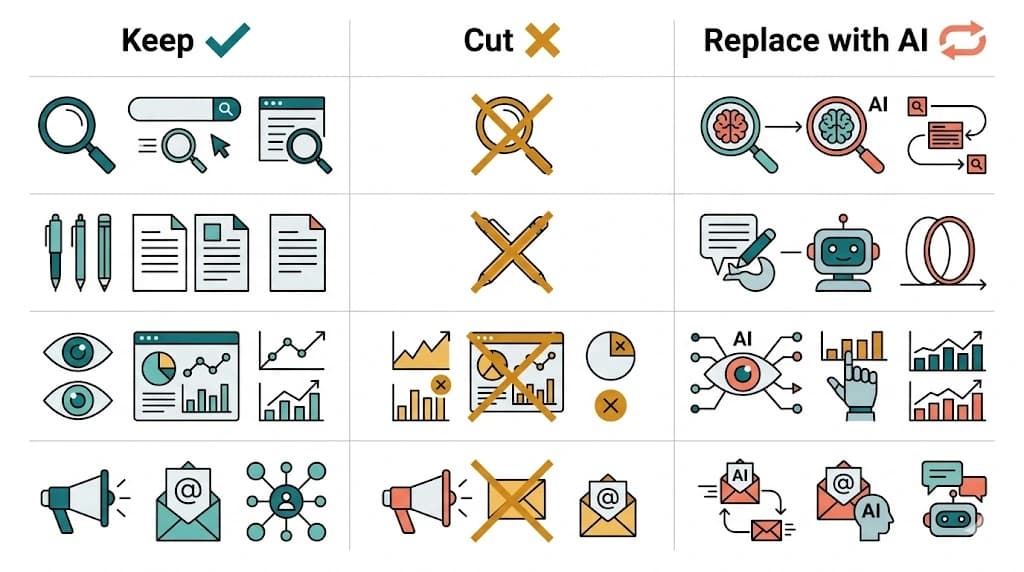
For implementation depth, use this post with the full SaaS marketing stack guide.
How the self-learning stack changes the compounding curve
Here is the compounding argument that makes this more than a cost consolidation story.
Every tool in the typical stack is stateless. Semrush does not remember that your last three high-performing blogs were on competitor gap analysis. Jasper does not know that the cold email angle about "manual SEO as a second job" got a 12% reply rate. Your rank tracker does not adapt based on which content types drove the most ranking improvements.
A self-learning AI CMO carries memory across every campaign. Open rates, reply rates, ranking changes, citation gains, Reddit engagement patterns: all of it feeds back into the next brief, the next email angle, the next content priority. The stack gets smarter with every campaign rather than resetting to zero each time.
In 2026, leading teams use AI agents to manage lifecycle campaigns, score leads in real time, and run predictive models. The compounding loop is not a future state. It is the current competitive baseline for teams that have made the transition.
The founders still running the 91-tool stack are not just paying more. They are starting every quarter from scratch while their competitors start from an accumulated intelligence base that gets deeper with every result.
FAQ
_Thoth audits your current stack against your SEO, AEO, GEO, and outreach gaps and builds the execution plan from one URL. Free audit at distribution.studio._
Back to all blogs