What is a keyword gap in SEO and how to close it
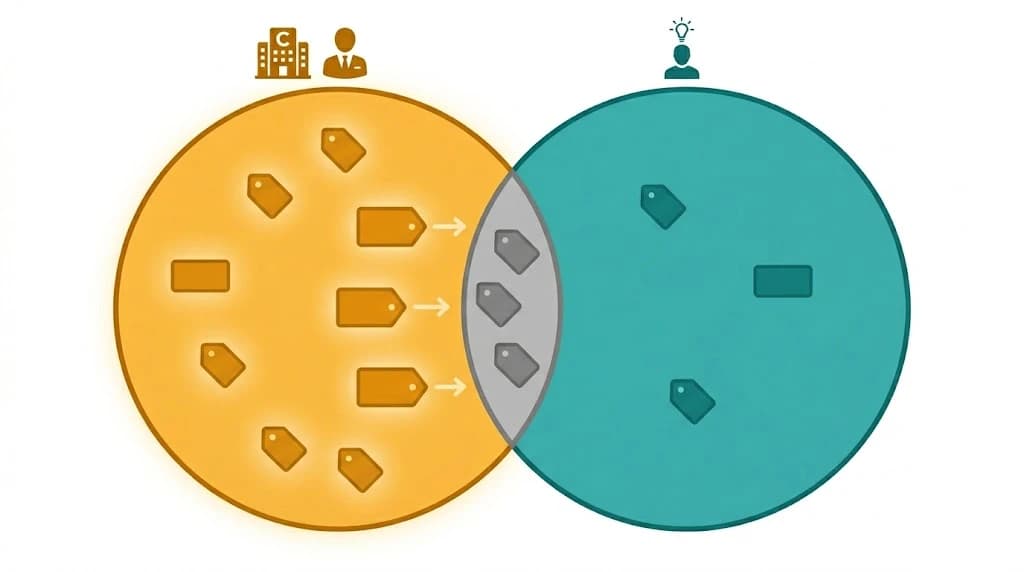
A keyword gap is a search term your competitor ranks for that you do not.
That is the whole definition. No jargon. No complexity.
Your competitor has a page that Google sends traffic to when someone searches for that term. You have no page - or a page that Google does not consider relevant enough to rank for it. The gap is the distance between their visibility and yours on that specific query.
The reason keyword gaps matter more than generic keyword research is validation. When you find a keyword through conventional research, you are estimating whether the term is worth targeting. When you find it through a competitor gap analysis, the question is already answered. Someone built a page for this keyword because real buyers search for it and it converts. You do not need to validate demand. Your competitor already ran that experiment for you.
A keyword gap is not a penalty or a mistake on your end - just a missed opportunity. These gaps often happen because SEO efforts focus too narrowly on a core set of target keywords, overlooking the long-tail keywords and topic variations your target audience actually uses.
This post covers exactly what keyword gaps are, how to find yours using only Google Search Console without a paid tool, how to prioritise which ones to close first, and why closing them manually is the constraint that keeps most SaaS teams stuck. For the AI search side, read about AI citation gaps alongside keyword gaps.
Whether you are running a SaaS in the US, UK, UAE, or across Europe, this applies — the tools and tactics here work regardless of market.
What is a keyword gap in SEO?
A keyword gap in SEO is a specific search query where a competitor has ranking visibility in Google and your site does not - either because you have no dedicated page targeting the query, or because your existing page does not rank within positions 1 to 30 for it.
Three types of keyword gaps exist, and each requires a different response:
Missing gap. You have no page at all for the keyword. Your competitor has one that ranks. This is the most common gap type and the clearest content brief you will ever receive - your competitor has already validated that the keyword drives traffic, and you simply need to build a better page.
Weak gap. You have a page that mentions the keyword but ranks at position 11 to 30 - visible enough for Google to show it, not visible enough to earn consistent clicks. Go through your GSC keywords and look for queries with zero or few clicks but significant impressions. Google thinks your content is relevant enough to include in results - but not relevant enough to rank where clicks happen. These are your fastest wins. A targeted improvement to an existing page moves a weak gap faster than creating new content from scratch.
AI citation gap. A query where a competitor is cited in ChatGPT, Perplexity, or Gemini answers and you are absent - even if you rank well in traditional Google results. The most valuable gap in 2026 often is not a missing keyword but a missing perspective - unique expertise and data that answer engines rely on to build their responses. AI citation gaps exist independently of Google keyword gaps and require different tactics to close.
Finding your keyword gaps is one part of the work. The bigger payoff comes from turning those gaps into a prioritised execution plan: which gaps to close first, which pages to build, which briefs to write. To find your competitor keyword gaps automatically and have them mapped to briefs and campaigns, see how Thoth's competitor gap analysis works.
Keyword gap vs content gap: the difference that changes your strategy
These two terms are often used interchangeably. They are not the same thing, and confusing them leads to the wrong fix.
A keyword gap is query-level - a specific search term your competitor ranks for that you do not. It is precise, measurable, and has a clear content response: create a page targeting that specific query.
A content gap is broader - it is the distinction between keyword cannibalization (multiple pages on your site competing for the same keyword) and keyword gaps (areas you have not targeted at all).
Think of it this way: a keyword gap tells you a specific door is missing from your house. A content gap tells you an entire room is missing. Keyword gaps get closed with targeted pages. Content gaps get closed with topic clusters - multiple interlinked pieces that build authority across a subject area.
Both matter. Keyword gaps give you quick wins. Content gaps give you long-term topical authority. A complete competitor intelligence system maps both and prioritises based on your current domain authority and content production capacity.
How to find your keyword gaps using only Google Search Console
You do not need Semrush or Ahrefs to find your most valuable keyword gaps. GSC gives you two gap types directly - and they are the highest-priority gaps to close because Google already associates your site with them.
Finding weak gaps in GSC (fastest wins):
Go to GSC: Performance > Search results > Queries tab. Sort by Impressions, highest to lowest. Filter for:
- Average position between 8 and 30
- Impressions above 50 (in the last 28 days)
- CTR below 3%
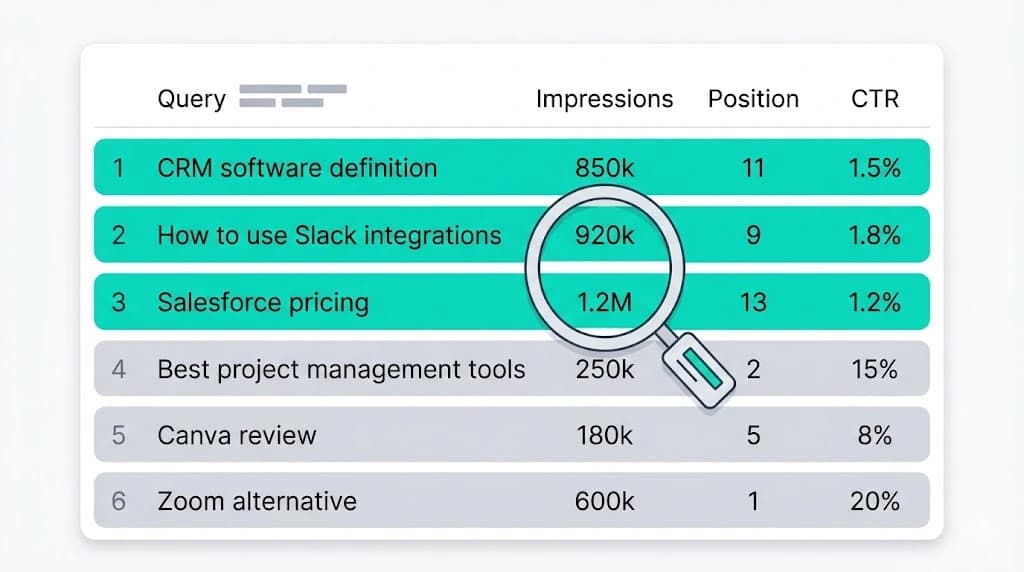
These are queries where you are getting impressions in position 11 to 30 but have no dedicated page - opportunities to create targeted content for queries you are already on the edge of ranking for.
Every query on that filtered list is a weak gap. Google has already decided your site is relevant for this term. You are not building authority from zero - you are closing the last gap between showing up and getting the click. A dedicated page or a targeted improvement to an existing one typically moves these from position 14 to position 3 within 30 to 90 days.
Finding missing gaps (requires cross-referencing a competitor):
This step requires knowing which domains are your actual SEO competitors - not your business competitors. Find them by searching your 10 most important keywords and noting which domains appear consistently in the top 10. Those are your real SEO competitors for this exercise.
Then manually check their sitemap or blog index. Every topic they have a page for that you do not is a potential missing gap. Cross-reference against your GSC data - if they rank for a keyword and you have zero impressions for it, that is a confirmed dark gap. No GSC signal, no existing page, competitor ranking. This is the highest-value gap type because it represents entirely uncaptured demand.
Without any third-party tool, you can surface:
- Your weak gaps from GSC in under 10 minutes
- Your dark gaps by manually comparing 3 to 5 competitor sites
The limitation: manual cross-referencing does not scale past 50 keywords per competitor and misses AI citation gaps entirely.
How to prioritise which keyword gaps to close first
A raw gap list is just a longer content backlog. Before any gap goes into a brief, score it across three dimensions.
Commercial intent. Google's algorithms in 2026 are increasingly sophisticated at identifying micro-intents. If the top three results for a keyword are all independent review listicles, the intent is commercial investigation. Attempting to fill that gap with a product landing page will likely never break the top five regardless of keyword density or backlink profile. Match the format of what is already ranking - then make yours more useful.
Look at the pages ranking for each gap keyword. Are they how-to guides, comparison pages, definition posts, or product pages? That is the format Google has decided satisfies the intent. Build in that format and go deeper.
Keyword difficulty vs your current authority. A domain with DA 25 cannot realistically close a gap held by five competitors with DA 70 each. Score gaps by whether you can win them in the next 90 days, not whether you would like to eventually. Keywords with difficulty scores of 20 to 40 are realistic targets for early-stage domains. Anything above 60 requires significant domain authority you likely do not have yet.
SERP feature opportunity. SERP features often capture up to 60% of the visual real estate above the fold in 2026. When you identify a gap where a competitor ranks first, the first question should not be "what is their keyword density?" It should be: "what SERP feature are they winning?"
If a competitor holds a Featured Snippet for a definition query, you beat them by providing a more precise, data-backed answer in the 40 to 60 word range that Google's parser prefers. If the SERP is dominated by video results, writing a 3,000-word blog post does not close the gap - you have a media gap, not a content gap.
AI citation potential. Does this keyword appear as a question in ChatGPT or Perplexity? Is the top-cited source thin, outdated, or poorly structured? High AI citation potential gaps - definition queries, how-to questions, comparison terms - can be closed faster through structured content than traditional SEO rankings ever move. A well-structured, schema-marked page can displace a weaker competitor citation within weeks.
The three-step process to close a keyword gap
Step 1: Match intent before writing a word.
Search the gap keyword. Read the top three results. Note the format, the depth, the angle. This is your minimum viable benchmark. Your page needs to do everything those pages do and then add something they cannot provide - original data, a more precise definition, a tactical framework they summarise but never explain, a perspective grounded in experience they are missing.
In 2026, more content is not always the answer when AI tools can generate summaries in milliseconds. The most valuable gap is often not a missing keyword but a missing perspective - providing the unique expertise and data that answer engines rely on to build their responses.
Step 2: Structure for both Google and AI extraction.
Answer-first paragraph structure means the direct answer appears in the first one to two sentences of every section - before any supporting context. This is what Google extracts for Featured Snippets and what AI systems cite in generated answers. Every gap you fill through a strong keyword gap strategy becomes a keyword your site can own, a topic your brand builds authority around, and an AI Overview opportunity where your content becomes eligible to be cited.
Add FAQPage schema to every page with a FAQ section. Add HowTo schema to every step-by-step guide. These make your Q&A pairs directly machine-readable and increase AI citation eligibility significantly.
Internal linking matters as much as the page itself. Link to the new page from every relevant existing post using the gap keyword as anchor text. This distributes authority to the new page faster than waiting for external links to accumulate.
Step 3: Close the loop, then move to the next gap.
Publish the page. Submit it to GSC for indexing. Set a reminder for 30 days to check the position. If it lands at position 8 to 15, the page needs deeper content or more internal links. If it lands at position 4 to 7, it needs a Featured Snippet optimisation pass - rewrite the first paragraph of the most relevant section as a clean 40 to 60 word direct answer.
The mistake most teams make is publishing and moving on before the first page has ranked. A page sitting at position 12 with a small improvement would move to position 4 and earn 10x the clicks. That improvement takes one hour. Most teams skip it and spend that hour publishing new content that will sit at position 12 and need the same pass six weeks later.
Why closing keyword gaps manually does not scale
Here is where the process breaks down for most SaaS teams.
You run the gap analysis. You find 40 confirmed gaps. You score them. You have a prioritised list of 15 to tackle first. Then the execution falls back on the same bottleneck: someone has to write 15 pieces of content, optimise them for both Google and AI extraction, publish them, and monitor what happens.
At one blog a week that is 15 weeks of work. Meanwhile your competitor is not pausing. They are publishing continuously, opening new gaps as fast as you close old ones. The gap between analysing once per month and monitoring continuously is where most growth stalls.
The second bottleneck is response speed. SERPs are increasingly personalised and localised - a keyword gap in one market might look entirely different in another. Gaps that exist today close within weeks when a competitor targets them. A monthly gap analysis cadence means your intelligence is always 30 days stale.
The complete version of how competitor gap analysis connects to execution - from GSC data to identified gap to published page - covers the full workflow. And building a system that closes gaps continuously rather than in periodic sprints is where the compounding advantage comes from.
Thoth connects GSC data to gap identification to content generation to publishing in one continuous workflow. A gap surfaces on Monday. The brief generates automatically. The content is written and published by Thursday. The next gap is already being identified while the first one is being indexed.
That is not a content calendar. It is a gap-closing system that runs without a human in the execution loop.
Free audit at distribution.studio - paste your URL and see your keyword gaps, near-win keywords, and AI citation gaps in 10 minutes.
FAQ
Thoth identifies your keyword gaps, near-win keywords, and AI citation gaps from one URL - then closes them with content written, structured, and published automatically. Free audit at Free audit at distribution.studio.
Back to all blogs