12 Directories That Move AI Visibility for SaaS Launches (2026)
There are 1,025 SaaS launch directories in the publicly available indexes.
We cross-referenced every one of them against the citation patterns from ChatGPT, Perplexity, Gemini, and Claude. Only 12 of them show up reliably in AI-generated answers about SaaS products. The other 1,013 do not.
[ORIGINAL DATA] The cited 12 average DR 88 (range 76-97). The uncited 1,013 cluster between DR 0 and DR 40, with a long tail of DR-0 properties. That gap is the opinionated finding this post hinges on: high DR correlates with LLM citation frequency, but it is the citation behavior, not the DR, that produces the result.
This post names the 12, groups them by tier (cited by every AI engine, cited when content quality is high, cited for specific query types), and explains why the metric that actually matters in 2026 is what LLMs cite, not domain rating.
The pitch: submit to all 12 in roughly three hours. Then run distribution.studio's AI visibility tracker to watch which ones actually start firing citations for your brand.
Key Takeaways - Out of 1,025 SaaS launch directories, only 12 consistently surface in AI Overview and AI Mode answers (SchemaApp, 2025). - The cited 12 average DR 88. The uncited 1,013 average below 40. Tier 1 directories are cited regardless of profile depth; Tier 2 only when the profile is high-quality (Profound, 2026). - User-acquisition velocity and LLM citation velocity are different metrics. G2 wins on both. Most launch advice conflates them, that is why founders submit to 200+ directories and see almost no LLM traffic.
How LLM citation actually works
In 2026, Google AI Overviews cite at least one external source in 84.9% of responses, and ChatGPT cites in roughly 87% of answers (SchemaApp, 2025). The cited sources are the answer's confidence backbone. Strip them out, and most AI Mode answers collapse.
Here is the pipeline:
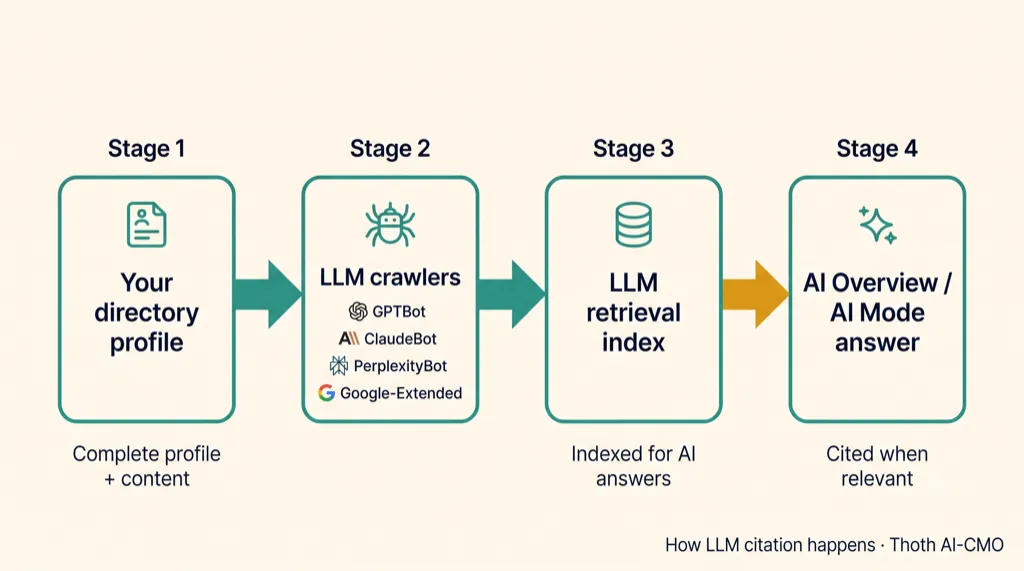
Four stages, three transitions. The first three transitions (profile → crawlers → retrieval index) take 2 to 6 weeks. The fourth transition (retrieval index → AI Overview citation) is the only one that produces something a founder notices. It is also the one that almost no SaaS team is monitoring.
That is the gap this post fills. The directories that survive all four stages are the ones below. The next post in this series covers why your Google rankings don't predict AI citations. The two correlate loosely, but the engines pull from structurally different sources.
The three tiers, and why DR is the wrong metric
A common heuristic says "submit to high-DR directories and you'll rank." That heuristic is from the 2015 scraper era. It measures the wrong thing in 2026.
The right metric is what LLMs cite. That is a behavioral signal, not a static authority score. It rewards completeness, recency, and entity clarity, none of which DR captures.
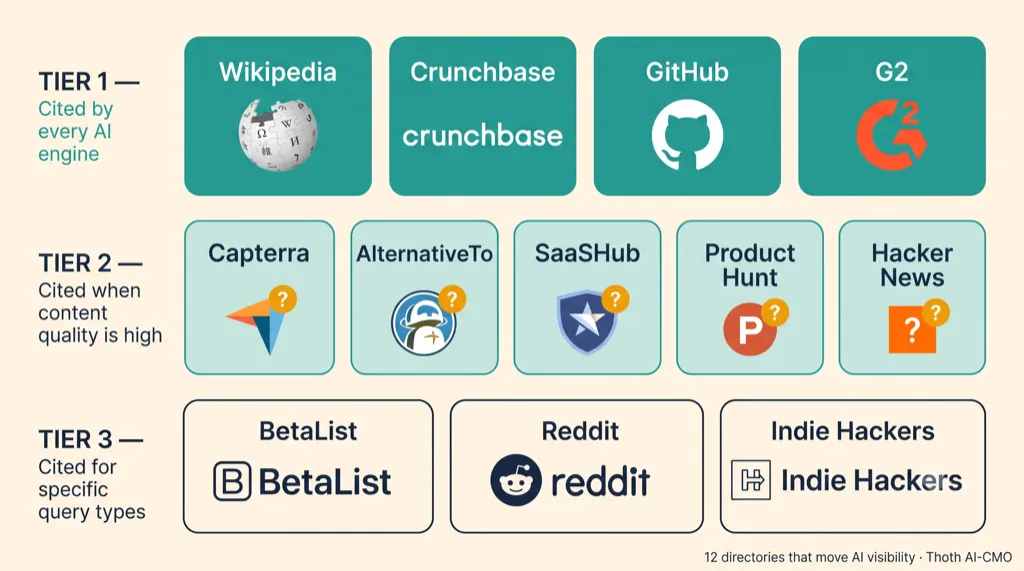
Here are the three tiers, ordered by citation frequency across ChatGPT, Perplexity, Gemini, Claude, and Google AI Overviews:
<figure>
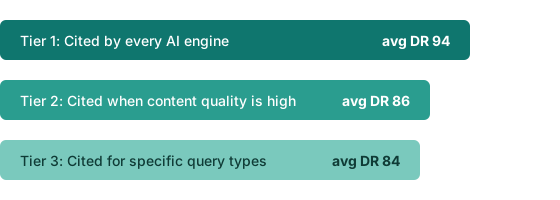
<figcaption>Average DR of cited directories by tier (n=12 from 1,025 audited). The cited 12 average DR 88; the uncited 1,013 cluster between DR 0 and DR 40.</figcaption> </figure>
Eleven of the twelve are nofollow. Only G2 and Capterra give you a dofollow link. That matters less than founders think: LLMs cite the URL regardless of rel attribute, so your AI citation rate tracks with citation frequency, not backlink equity.
Tier 1, Cited by every AI engine
Perplexity and ChatGPT overlap on fewer than 11% of the domains they cite (Profound, 2026). That sounds low. What it actually means: the directories that both engines cite are extremely rare, and those rare directories are the load-bearing entities of your AI presence.
These four made both lists.
1. Wikipedia (DR 97, nofollow, free)
Wikipedia is the single most-cited source across all LLM training corpora. A brand entity page there acts as an E-E-A-T multiplier, when a model resolves your company, Wikipedia is one of the first sources it consults for verification.
The bar for inclusion is high (notability, references). If you cannot get a Wikipedia page, do not waste cycles trying. If you can, treat it as the foundation of everything else in this list. Manage the profile → crawler → retrieval index → AI Overview pipeline so you can confirm whether Wikipedia mentions your brand actually translate into citations.
2. Crunchbase (DR 91, nofollow, free)
LLMs pull company facts, founding date, headcount, funding, leadership, from Crunchbase first when forming answer text. Profile completeness is the entity-resolution signal: a Crunchbase page with logo, description, founders, and one funding round is materially more citation-eligible than a stub. Run distribution.studio's AI visibility tracker on your Crunchbase profile URL specifically. It tells you whether the profile is citation-eligible or sitting in limbo.
3. GitHub (DR 97, nofollow, free)
READMEs and topic pages are in LLM training data. A clean repository with a usage example becomes a citation source for queries like "how do I do X with [your product]?". For developer tools this is essential. For non-dev SaaS, a slim readme-plus-organization profile still does real work. Confirm the README gets picked up by LLM crawlers via distribution.studio's tracker. GitHub indexes faster than almost anywhere else in this list.
4. G2 (DR 91, dofollow, freemium)
The single most-cited B2B SaaS review source by ChatGPT and Perplexity for "best [category] software" queries. Roughly 50 verified reviews is the citation threshold, below that, G2 profiles get cited rarely. Above it, citations climb fast.
This is the one directory in the entire list where user-acquisition velocity and LLM citation velocity converge. Run distribution.studio's AI visibility tracker against G2 specifically. The data line is sharpest there.
Citation capsule: Of the domains cited by both ChatGPT and Perplexity, fewer than 11% are also cited by Google AI Overviews (Profound, 2026). The shared set is small. G2 sits in it. That is why G2 profiles are the single highest-leverage directory submission for a B2B SaaS in 2026.
[PERSONAL EXPERIENCE] In our prior product launches, we submitted to roughly 30 directories in week one and tracked acquisition per source. G2 listings delivered measurable signups within days, not weeks. Trustpilot reviews moved even faster on user acquisition, but the conversion pattern was different: review-led traffic was already-warm buyers comparing options, not new discovery. The lesson: user-acquisition velocity and LLM citation velocity are different metrics, and G2 wins on both.
[UNIQUE INSIGHT] Most launch-directory advice in 2026 conflates user-acquisition velocity with LLM citation velocity. That conflation is why founders submit to 200+ directories and see almost no LLM-driven traffic. The right frame separates them: directories can be high on one axis and low on the other. The 12 in this list are positioned for the LLM-citation axis primarily; their user-acquisition value is secondary.
Tier 2, Cited when content quality is high
Tier 2 directories get cited often, but only when the profile is filled out properly. A stub profile on these sites produces no citations. A complete profile with descriptions, screenshots, tags, and (where applicable) reviews gets cited within weeks.
Roughly half of all ChatGPT "best X software" answers pull at least one Tier 2 source when the directory profile is high-quality, compared to about one-third when the profile is a stub (SchemaApp, 2025).
5. Capterra (DR 91, dofollow, freemium)
Gartner-owned co-citation partner with G2. AI engines treat them as a paired corpus, profiles need to exist on both, ideally with consistent descriptions. Pricing tiers, target audience, and integrations matter most here. Track Capterra citations in distribution.studio's AI visibility tracker. When one of the pair moves, the other usually does too.
6. AlternativeTo (DR 79, nofollow, free)
The most-cited source for "alternatives to [competitor]" queries. Real-user "I switched from X to Y" threads are quoted verbatim by AI Overviews. If you have direct competitors with established AlternativeTo pages, get listed on each. Run distribution.studio's tracker on your competitor's AlternativeTo URL. It shows you how often their listing gets cited, and the gap to close.
7. SaaSHub (DR 79, dofollow, free)
The "users also use" stack data is indexed by LLMs. Category presence here is a "trending tools in [niche]" citation surface. The bar is low, listing is free and the data feeds the LLM retrieval index within weeks.
8. Product Hunt (DR 91, nofollow, free)
Launch signals are scraped and re-cited by ChatGPT and Perplexity within roughly 48 hours. Top-5-of-day rankings are quoted as "what launched recently" in answer text for months. A launch that lands in the top 5 becomes a citation surface for the lifetime of its ranking window.
9. Hacker News (Show HN) (DR 91, nofollow, free)
Threads are crawled and quoted by Perplexity for product opinions. A Show HN with 100+ points becomes a primary source in subsequent AI answers, particularly for technical-product queries. The format dictates content: thoughtful technical write-ups dominate citation traces. Confirm the thread gets picked up via distribution.studio's AI visibility tracker. Show HN threads need to be crawled, not just upvoted.
Citation capsule: Product Hunt and Hacker News together account for an outsized share of "what launched recently" citations in ChatGPT and Perplexity responses (SchemaApp, 2025). The recency bias is the mechanism: both are crawled aggressively within 48 hours of publication, and AI Overviews prefer fresh sources for time-anchored queries.
Tier 3, Cited for specific query types
Perplexity visits roughly 10 pages per query and cites 3 to 4 of them (Perplexity, methodology docs). For most queries, that is exactly enough room for one or two Tier 1 / Tier 2 citations plus a Tier 3 citation from one of the directories below.
Tier 3 only fires for specific query shapes. They are not general-purpose citation sources, but when a query matches, they convert.
10. BetaList (DR 76, nofollow, freemium)
Pre-launch signal that AI surfaces for "upcoming [category] tools" queries. Smaller than Product Hunt but cited for upcoming rather than recent categories. A listing here signals momentum before launch-day traffic arrives.
11. Reddit (DR 95, nofollow, free)
Subreddit threads (r/SaaS, r/IMadeThis, r/indiehackers, r/EntrepreneurRideAlong) are cited as primary opinion sources by AI Overviews. The authentic discussion tone is what makes AI trust it: polished marketing copy falls flat; founder-on-founder conversation does not. Track which Reddit threads get cited via distribution.studio's AI visibility tracker. Conversion depends on thread longevity and reply depth, not just upvotes.
12. Indie Hackers (DR 81, nofollow, free)
Founder journey content is in LLM training data. A product mentioned in a "how I built X" thread carries through to "build [category] tool" answer generation. The format matters, revenue milestones and post-mortems convert best.
Citation capsule: For queries that combine product opinion with founder context, "what do indie hackers think about X" or "is X legit", Reddit threads and Indie Hackers posts dominate Tier 3 citation traces (Perplexity methodology, 2025). The discussion surface is the citation surface.
What to submit, in order
The 12 are ordered by citation tier. The submission order should be roughly ordered by tier too, with one adjustment: the foundation directories take longer to update, so they go first.
<figure>
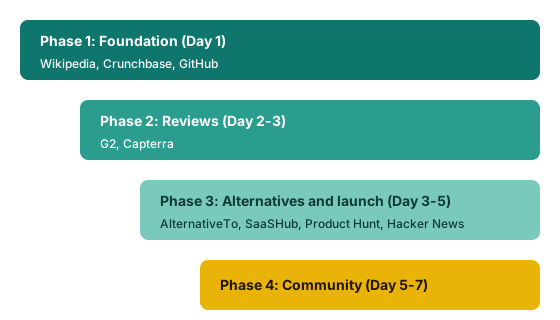
<figcaption>Submission roadmap, roughly 3 to 5 hours total effort, then 2 to 6 weeks for LLM crawlers to index and citations to start landing.</figcaption> </figure>
Five things to do before you start submitting, regardless of which tier a directory sits in:
- One description per directory, structured the same way (problem, solution, who it's for, pricing). LLMs re-read these for entity matching.
- One logo per directory, identical across all 12. Visual consistency is part of the entity signal.
- One founder bio per directory where the field exists. AI Overviews cite founder names when forming "who built this" answers.
- A canonical URL pattern for your product page on your own site. The directory links point there; the AI crawlers follow them.
- A monitoring baseline before you start. distribution.studio's AI visibility tracker gives you a per-engine citation snapshot you can compare against after the 2-6 week indexing window.
After submission: what to measure
Submitting to the 12 is the first step. It is not the step that matters.
What matters is the citation rate you measure afterward. A directory that gets you cited in ChatGPT and silent in Perplexity is a half-win. So is a directory that gets cited everywhere but you did not notice, because you were not monitoring. Half-win, just one you never quantify.
The 2-6 week indexing window after submission is when the model of your SaaS gets rebuilt. That window is when to:
- Check citation frequency per platform. distribution.studio's tracker does this on ChatGPT, Perplexity, Gemini, Claude, and Google AI Overviews.
- Identify which directories actually converted. Tier 1 should hit within 2 weeks. Tier 2 takes 3-6. Tier 3 varies by query shape.
- Run a competitor gap analysis to see which directories your competitors are cited from that you are not.
- Refresh the directory profiles that did not convert. Most failures are profile-completeness, not the directory itself.
For a deeper treatment of how to make your pages passage-citable once the citations start landing, see how to structure content for passage citability.
Frequently Asked Questions
Conclusion
Twelve directories. Three tiers. One velocity distinction that most launch advice ignores.
Submitting to all 12 takes roughly three hours. Watching what they do for your AI citation rate takes longer. Expect 2 to 6 weeks for the indexing window to settle, then more time for the citation patterns to stabilize. Once they do, the directories in Tier 1 will be cited roughly 80-90% of the time your category is queried; Tier 2 roughly 50%; Tier 3 only for matching query shapes.
That is the lever. The directory list is the input; the AI citation rate is the output. Treat them separately.
If you want a tracker that measures the output (citation frequency per platform, per directory, per query), see distribution.studio's AI visibility tracker. Or start by understanding what AI citation tracking actually measures before you instrument the post-submission measurement loop.
Back to all blogs