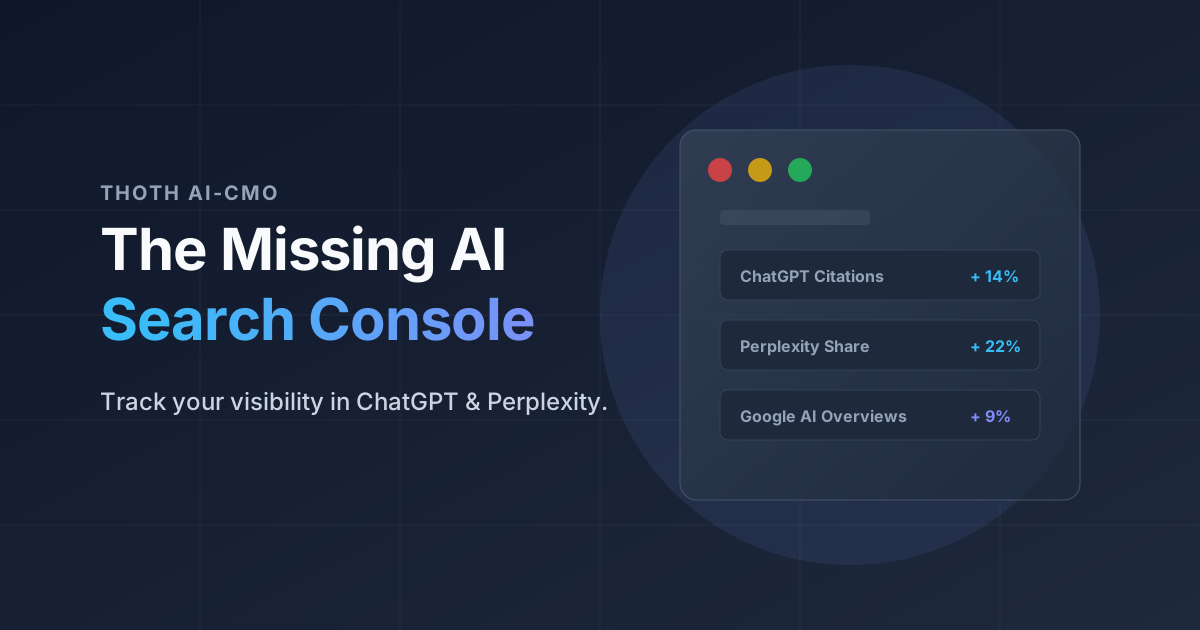
You are staring at Google Search Console while your customers are asking ChatGPT.
Search engine volume is projected to drop 25% by 2026. Your audience is fundamentally shifting how they find software. They are no longer typing fragmented keywords into Google and scrolling past four sponsored ads. They are having conversations with AI models.
But right now, you have a massive blind spot. There is no unified "AI Search Console" to tell you if ChatGPT, Perplexity, Claude, or Google AI Overviews are citing your product. Worse, you don't know if they are confidently recommending your biggest competitor.
If you don't know your share of voice in the generative AI era, you don't have a modern SEO strategy. You have a legacy one.
The playbook has changed. Welcome to the era of Generative Engine Optimization (GEO) and Answer Engine Optimization (AEO).
The GSC Illusion
We all rely on Google Search Console. For a decade, it was the only dashboard that mattered. It told you what you ranked for, who clicked, and what pages were broken. But in the era of GEO optimization, GSC only tells half the story.
Google recently rolled out Google Search Console AI performance reports. Helpful? Sure. It shows you impressions and clicks from Google's own AI Overviews. But that ecosystem is a walled garden.
Those reports tell you nothing about how often you are mentioned by ChatGPT—which just launched its own real-time web search. They tell you nothing about Perplexity, the engine rapidly becoming the default research tool for B2B buyers. They give you zero visibility into Claude's artifact generations.
If your buyer asks Perplexity "best CRM for manufacturing", and you aren't listed in the sources, you didn't just lose a click. You lost the entire consideration phase. You cannot track that loss in GSC.
The Death of Traditional Keyword Tracking
In the traditional SEO world, you open a tool, look up a keyword with 5,000 monthly searches, write a 2,000-word guide, and fight for a top-three spot.
In the AI search world, that 5,000-volume keyword is now 5,000 unique, long-tail conversational prompts. An LLM does not match keywords; it synthesizes concepts. It looks for entities, relationships, sentiment, and structured data.
To win at AEO optimization, you need to know exactly how to feed these new engines with structured data, clear FAQs, and machine-readable content like llms.txt files.
If your website is built purely for Google's crawler, an LLM will struggle to extract the nuanced differences between you and your competitor. When an LLM struggles to parse your product's value, it defaults to citing the industry giant.
What Most Teams Get Wrong
Without an official dashboard from OpenAI or Anthropic, marketing teams are trying to piece this AI visibility data together manually.
They analyze server logs for specific bot user agents (like ChatGPT-User or PerplexityBot). They attempt to filter referral traffic in GA4 to guess if a visit came from an AI chat interface. Or they spend hours every Sunday evening manually prompting ChatGPT with variations of their target keywords to see if their brand name pops out.
It is imprecise, unscalable, and completely misses the context.
Knowing that ChatGPT crawled your site does not tell you why the LLM recommended a competitor instead of you when the buyer actually asked a question. It doesn't tell you what structured data you are missing to secure that citation.
The Dashboard Gap: Homework vs. Outcomes
Even if you managed to build a custom dashboard tracking your AI visibility, you run into the classic SEO tool trap.
Most SEO tools give you a dashboard full of problems.
Semrush offers you a lifetime supply of dashboards, a 90-item backlog of broken links, and keyword gaps based on estimated database volumes. You get a list of 400 keywords your competitor ranks for that you don't.
Surfer SEO gives you a content editor and an optimization score. You still have to do the research, write the draft, hit the score, and hit publish.
You get homework, not results. A true AI Search Console needs to move beyond reporting.
| Traditional SEO Tools | Autonomous AI Search (Thoth) |
|---|---|
| Data Source: Keyword database guesses | Data Source: Real GSC data and LLM citation monitoring |
| Output: Diagnostic errors and spreadsheets | Output: Written, published pages closing citation gaps |
| Execution: Manual human effort required | Execution: SEO autopilot via an AI CMO |
The Autonomous Fix
Traditional SEO tools give you data. A consultant joins that data in their head, builds a plan, briefs a writer, reviews the draft, publishes the page, and monitors the indexation. That is 15–20 hours a week you do not have.
Thoth AI-CMO does the join in the workflow.
Until OpenAI and Perplexity release standardized webmaster tools, platforms like Thoth act as your de facto AI Search Console. But Thoth goes beyond tracking. It is an AI SEO agent that actually executes the fix.
We built Thoth because looking at a dashboard of missing AI citations doesn't fix the problem. Publishing optimized content fixes the problem. Thoth is the engine that closes the loop between data and output via programmatic SEO and autonomous SEO.
→ Instant AI visibility tracking. Monitor brand mentions across ChatGPT, Perplexity, and Claude to see your true share of voice in real-time. → Competitor gaps identified from real data. Find the exact questions LLMs are answering where they cite your competitor, mapped to your cluster graph. → AEO and GEO optimization baked in. Get cited in the ChatGPT answers your customers are already asking by structuring your content exactly how LLMs want to read it. → Blog written, optimized, published. You didn't touch it. Thoth generates the pages, applies the SEO structure, and pushes directly to Ghost CMS. → Self-learning memory. Every campaign makes the next one sharper. Automatically.
Stop Flying Blind
The transition to AI-driven search requires a fundamental shift in how you optimize digital visibility. Relying on legacy tools to track next-generation search engines is a guaranteed path to obscurity.
Waiting for an official dashboard from OpenAI means you are already losing market share to the competitors who are actively deploying SEO automation today. Most tools tell you what's wrong. Thoth fixes it.
Get an instant, free SEO, AEO, and GEO audit at distribution.studio. See every gap in your site before your competitor does.
Back to all blogs